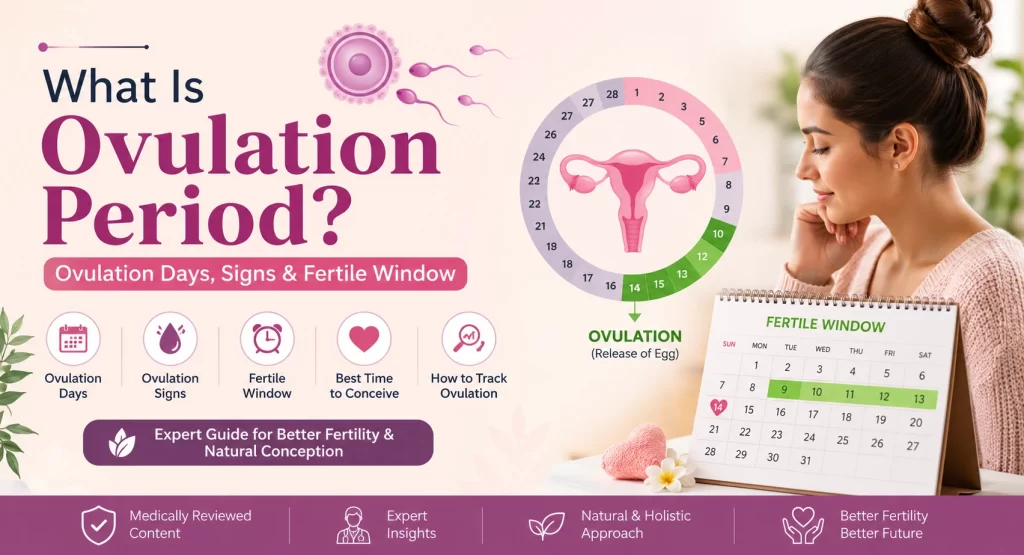
What Is Ovulation Period? Ovulation Days, Signs & Fertile Window
Written by: Aasha Ayurveda Editorial Team
Medically Reviewed by: Dr. Chanchal Sharma
BAMS, MD (AM), CGO | 15+ Years of Experience
Director – Aasha Ayurveda
Last Medically Reviewed: August 2026
If you are trying to get pregnant, understanding your ovulation period can help you identify the days when conception is more likely.
Ovulation is the release of a mature egg from an ovary. The egg then enters the fallopian tube, where fertilization may happen if sperm are present.
A common belief is that every woman ovulates on Day 14, but this is not true. In a typical 28-day cycle, ovulation may happen around Day 14, but the actual day varies according to cycle length and from one cycle to another.
For pregnancy planning, it is more useful to understand your fertile window, ovulation signs and menstrual cycle pattern rather than relying only on a fixed calendar date. You can also read our detailed guide on Ayurvedic Treatment for Ovulation to understand ovulation-related concerns in more detail.
What Is Ovulation Period?
Ovulation is the time when an ovary releases an egg. The egg normally remains available for fertilization for only a short period, while sperm can survive in the female reproductive tract for several days.
Because of this, the fertile window is wider than the ovulation day itself. It generally includes the days before ovulation and the day of ovulation.
| Question | Quick Answer |
| What is ovulation? | Release of a mature egg from an ovary |
| Is ovulation always on Day 14? | No |
| How long does the egg survive? | About 12–24 hours |
| How long can sperm survive? | Up to about 5 days |
| What is the fertile window? | Roughly 6 days ending around ovulation |
| Best time for pregnancy? | Usually the days just before and around ovulation |
Ovulation, Ovulation Day and Fertile Window: What Is the Difference?
These terms are often used as if they mean the same thing, but they are different.
Ovulation
Ovulation is the release of an egg from the ovary.
Ovulation Day
This is the day on which the egg is released.
Fertile Window
The fertile window includes several days because sperm may remain alive before the egg is released.
Menstrual Cycle
The menstrual cycle starts on Day 1 of one period and ends the day before the next period begins.
Understanding these differences is important because pregnancy is possible even when intercourse occurs before the actual ovulation day.
How Does Ovulation Happen?
Ovulation is controlled by a coordinated interaction of reproductive hormones.
The menstrual cycle can broadly be understood in four phases.
1. Menstrual Phase
Day 1 of bleeding is counted as the first day of the menstrual cycle.
During menstruation, the uterine lining is shed.
2. Follicular Phase
Several ovarian follicles begin developing under hormonal signals.
Usually, one follicle becomes dominant and contains the egg that may be released during ovulation.
The length of this phase can vary, which is one reason ovulation does not happen on the same cycle day in every woman.
3. Ovulation
A rise in luteinizing hormone (LH) helps trigger the release of the mature egg.
After release, the egg moves toward the fallopian tube.
4. Luteal Phase
After ovulation, the body produces progesterone to help prepare the uterine lining for a possible pregnancy.
If pregnancy does not occur, hormone levels fall and the next period begins.
Women whose cycles are frequently unpredictable may have an underlying menstrual disorder that deserves proper evaluation.
When Does Ovulation Occur?
For someone with a 28-day menstrual cycle, ovulation may occur around Day 14.
However, this is only an example.
It is generally more useful to estimate ovulation in relation to the next expected period rather than assuming every woman ovulates exactly 14 days after menstruation starts or ends.
Cycle length can change because of:
- stress
- illness
- PCOS
- thyroid problems
- weight changes
- excessive exercise
- age
- hormonal changes
Therefore, calendar calculations should always be treated as estimates.
Is Ovulation Always on Day 14?
No. Ovulation does not always happen on Day 14.
The “Day 14” idea comes from a textbook example of a 28-day menstrual cycle.
Someone with a shorter cycle may ovulate earlier, while someone with a longer cycle may ovulate later.
| Average Cycle Length | Estimated Ovulation Day* |
| 24 days | Around Day 10 |
| 26 days | Around Day 12 |
| 28 days | Around Day 14 |
| 30 days | Around Day 16 |
| 32 days | Around Day 18 |
| 35 days | Around Day 21 |
These are estimates only. Actual ovulation may vary.
After How Many Days of Period Does Ovulation Occur?
There is no fixed number of days after a period ends when every woman ovulates.
For example, someone with a short menstrual cycle may ovulate only a few days after bleeding stops. Someone with a longer cycle may ovulate considerably later.
A better approach is:
Estimate the next expected period → count approximately 14 days backward → use this only as an estimated ovulation day.
Ovulation tracking methods can provide more useful information than calendar counting alone.
If your periods frequently change from one month to another, read more about irregular periods and pregnancy chances.
What Is the Fertile Window?
The fertile window is the group of days in the menstrual cycle during which pregnancy is most likely.
It exists because:
- sperm may survive for several days
- the egg survives only for a relatively short time after ovulation
For practical fertility planning, the fertile window is often considered approximately the five days before ovulation plus the day of ovulation.
This means pregnancy can occur even if intercourse happened before the egg was actually released.
Which Days Are Best to Get Pregnant?
The highest chance of conception is generally around the days immediately before ovulation and around ovulation itself.
This happens because sperm can already be present in the reproductive tract when the egg is released.
Example
If estimated ovulation is Day 14, the fertile window may roughly include:
Day 9 → Day 14
This is only an example for understanding the concept.
Couples trying to conceive do not necessarily need to identify one exact hour of ovulation. Regular intercourse during the fertile window is generally more practical than trying to predict one precise moment.
Can You Get Pregnant Before Ovulation?
Yes.
Pregnancy can occur from intercourse in the days before ovulation because sperm may survive long enough to fertilize the egg after it is released.
This is why the fertile window starts before ovulation day.
Can You Get Pregnant After Ovulation?
Pregnancy may still be possible shortly after ovulation because the egg remains capable of fertilization for a limited time.
However, chances decrease as more time passes after ovulation.
This is why timing intercourse before and around ovulation generally provides a wider opportunity for conception.
What Are the Signs of Ovulation?
Some women notice clear ovulation signs, while others notice almost nothing.
1. Changes in Cervical Mucus
Near ovulation, cervical mucus may become:
- clear
- slippery
- wet
- stretchy
- similar to raw egg white
This type of mucus may help sperm move through the reproductive tract.
2. LH Surge
Ovulation predictor kits detect a rise in luteinizing hormone (LH).
An LH surge usually means ovulation may be approaching, although the test cannot guarantee that an egg will actually be released in every situation.
3. Basal Body Temperature Rise
After ovulation, progesterone can cause a small rise in basal body temperature.
Because this rise generally occurs after ovulation, BBT is often more useful for confirming a pattern than for predicting ovulation in advance.
4. Mild One-Sided Pelvic Pain
Some women experience mild lower abdominal discomfort around ovulation. This is sometimes called mittelschmerz.
Pain alone is not a reliable ovulation test.
5. Increased Libido
Some women notice changes in sexual desire around the fertile window.
This is a nonspecific symptom and should not be used alone to predict ovulation.
6. Breast Tenderness or Bloating
Hormonal changes can sometimes cause breast tenderness or bloating.
These symptoms can also occur at other times in the menstrual cycle.
Which Ovulation Signs Are Most Useful?
| Method or Sign | What It Tells You |
| Ovulation Predictor Kit | Detects an LH surge before expected ovulation |
| Cervical Mucus | Can identify fertile-type mucus |
| Basal Body Temperature | Helps confirm an ovulation pattern after temperature rise |
| Calendar Tracking | Gives an estimate based on previous cycles |
| Pelvic Pain | Possible clue but not reliable |
| Libido Change | Nonspecific |
| Breast Tenderness | Nonspecific |
Using more than one method can sometimes provide a clearer picture.
How to Track Your Ovulation Period
There are several ways to estimate or track ovulation.
Calendar Method
Track the first day of each period and calculate average cycle length.
This works better when periods are regular and becomes less reliable with irregular cycles.
Ovulation Predictor Kits
Urine ovulation kits detect the LH surge that commonly happens before ovulation.
However, certain hormonal conditions such as PCOS can sometimes make LH-based interpretation more difficult.
Cervical Mucus Tracking
Fertile cervical mucus tends to become wetter, clearer and more stretchy around ovulation.
Tracking your own pattern across multiple cycles is more useful than comparing your discharge with someone else’s.
Basal Body Temperature
Measure your temperature each morning before getting out of bed.
A sustained temperature rise may suggest that ovulation has already occurred.
Ultrasound and Hormone Testing
When fertility problems or irregular ovulation are suspected, healthcare professionals may use ultrasound, blood tests or other clinical assessments.
Ovulation Period and Pregnancy: Why Is It Important?
Ovulation is necessary for natural conception because an egg must be available for fertilization.
However, ovulation alone does not guarantee pregnancy.
Successful conception also depends on factors such as:
- sperm health
- fallopian tube function
- fertilization
- embryo development
- uterine environment
- age
- overall reproductive health
If you have been trying to conceive without success, our infertility treatment resource explains other male and female fertility factors that may need evaluation.
Does Regular Ovulation Guarantee Pregnancy?
No.
Someone may ovulate regularly and still face difficulty conceiving.
Possible factors include:
- blocked fallopian tubes
- male-factor infertility
- endometriosis
- uterine factors
- egg quality
- age-related fertility decline
- other reproductive conditions
If ovulation is occurring but conception is not happening, a broader fertility assessment may be required.
You can read more about the common causes and evaluation of female infertility.
How Do Fallopian Tubes Affect Fertility After Ovulation?
After ovulation, the egg enters a fallopian tube. This is where sperm and egg normally meet for fertilization.
Therefore, releasing an egg is only one part of conception.
If one or both fallopian tubes are damaged or blocked, natural conception may become more difficult depending on the location and severity of the problem.
For more information, see our guide to fallopian tube blockage treatment.
What If You Are Not Ovulating?
When an egg is not released during a menstrual cycle, it is called anovulation.
Repeated anovulation can make pregnancy more difficult.
Possible signs may include:
- very irregular periods
- very long menstrual cycles
- missed periods
- unpredictable bleeding
- difficulty becoming pregnant
Several conditions can affect ovulation.
What Causes Irregular or Absent Ovulation?
PCOS
PCOS is one of the common causes of irregular ovulation.
Possible symptoms include:
- irregular periods
- missed periods
- acne
- increased facial/body hair
- weight-related concerns
- difficulty conceiving
Women experiencing these symptoms can learn more about PCOS treatment.
Thyroid Disorders
Both underactive and overactive thyroid conditions can influence menstrual cycles and ovulation.
Significant Weight Changes
Being significantly underweight, sudden weight loss or substantial weight gain may affect reproductive hormones.
Excessive Exercise
Intense exercise combined with low energy intake may interfere with normal menstrual function in some women.
Stress
Physical and emotional stress can affect cycle timing and sometimes delay ovulation.
Other Hormonal Conditions
Other endocrine or reproductive conditions may also interfere with normal ovulation and require medical assessment.
PCOS and Ovulation: What Is the Connection?
PCOS can interfere with regular follicle development and ovulation.
Some women with PCOS ovulate occasionally rather than every cycle. Others may have long or unpredictable cycles.
This can make calendar-based fertile-window calculations less accurate.
If your cycles are irregular and PCOS symptoms are present, relying only on a Day-14 calculation is not recommended.
Irregular Periods and Ovulation
Irregular periods do not automatically mean that a woman never ovulates.
However, they can indicate that ovulation is happening unpredictably.
This creates two practical problems:
- It becomes difficult to estimate fertile days.
- Pregnancy timing becomes harder.
If cycle length changes significantly from month to month, our guide on irregular periods and pregnancy chances explains this relationship in more detail.
Can You Ovulate Without Getting Regular Periods?
It is possible to ovulate occasionally even when cycles are irregular.
However, very irregular or absent periods can be associated with irregular ovulation or anovulation.
Because there is no simple calendar rule in such cases, medical evaluation and more reliable ovulation tracking methods may be useful.
Ovulation and Age: Does Fertility Change After 35?
Female fertility does not suddenly stop at age 35.
However, fertility generally declines with age, with the decline becoming more noticeable during the mid-to-late 30s.
Age can affect:
- egg number
- egg quality
- chances of conception
- risk of pregnancy loss
Because time becomes more important with increasing reproductive age, fertility evaluation may be recommended earlier for people aged 35 or above who are having difficulty conceiving.
When Should You See a Fertility Specialist?
Consider medical evaluation if:
- you are under 35 and have been trying for about 12 months without pregnancy
- you are 35 or older and have been trying for about 6 months
- you are over 40 and trying to conceive
- periods are very irregular or absent
- you suspect you are not ovulating
- you have known PCOS or endometriosis
- you have a history of pelvic infection or tubal disease
- there is a known male fertility issue
You do not always need to wait 6 or 12 months when a known condition may already affect fertility.
Dr. Chanchal Sharma’s Clinical Perspective
Understanding ovulation can help couples plan pregnancy, but it should not become a source of unnecessary stress. Day 14 is only an example and does not apply to every menstrual cycle.
When periods are irregular, estimating fertility only through calendar dates can be misleading. Menstrual history, cervical mucus, ovulation testing and, when required, clinical evaluation can provide a clearer picture.
If a woman appears to ovulate regularly but pregnancy is still not occurring, other fertility factors such as sperm health, fallopian tube patency and reproductive health should also be considered.
Dr. Chanchal Sharma
BAMS, MD (AM), CGO
Director – Aasha Ayurveda
Please get the final clinical quote approved by Dr. Chanchal Sharma before publication.
Frequently Asked Questions
Q1. What is ovulation?
Ovulation is the release of a mature egg from an ovary. The egg then enters the fallopian tube, where it may be fertilized if sperm are present.
Q2. What is an ovulation period?
People often use “ovulation period” to describe the fertile part of the menstrual cycle. Ovulation itself is the egg-release event, while the fertile window includes several days around it.
Q3. After how many days of period does ovulation occur?
There is no fixed number of days after a period when everyone ovulates. In a 28-day cycle, ovulation may happen around Day 14, but shorter and longer cycles can have different ovulation days.
Q4. Is ovulation always on Day 14?
No. Day 14 is only a common example for a 28-day cycle. Ovulation timing differs according to cycle length and may vary between cycles.
Q5. How many days after periods are fertile?
Fertile days depend on when ovulation occurs rather than how many days have passed since bleeding ended. The fertile window generally includes several days before ovulation and the ovulation day.
Q6. How long does ovulation last?
The actual egg-release event is brief. Once released, the egg usually remains capable of fertilization for roughly 12–24 hours.
Q7. What are the best days to get pregnant?
The days immediately before ovulation and around ovulation are generally among the most fertile because sperm can already be present when the egg is released.
Q8. Can I get pregnant before ovulation?
Yes. Sperm can survive in the reproductive tract for several days, so intercourse before ovulation can result in pregnancy.
Q9. How do I know I am ovulating?
Useful clues include fertile cervical mucus, a positive LH ovulation test and a sustained basal body temperature rise after ovulation.
Q10. Does egg-white discharge mean ovulation?
Clear, slippery and stretchy cervical mucus often appears around the fertile window, but mucus alone cannot confirm that ovulation has occurred.
Q11. Can PCOS affect ovulation?
Yes. PCOS may cause irregular or absent ovulation and can make fertile-window calculations less predictable.
Q12. Can you ovulate with irregular periods?
Yes, some women with irregular periods still ovulate, but the timing may be unpredictable.
13. Does regular ovulation guarantee pregnancy?
No. Pregnancy also depends on sperm health, fallopian tubes, fertilization, embryo development and other reproductive factors.
Q14. When should I consult a fertility doctor?
Seek fertility advice after about 12 months of trying if under 35, after about 6 months if 35 or older, or earlier when there are irregular periods, known reproductive problems or other fertility concerns.
Key Takeaways
- Ovulation means the release of an egg from an ovary.
- Not every woman ovulates on Day 14.
- Ovulation is better understood in relation to the entire menstrual cycle and next expected period.
- The fertile window includes several days because sperm can survive before ovulation.
- The days immediately before ovulation and around ovulation are generally highly fertile.
- Cervical mucus, LH kits, BBT and cycle tracking can help identify ovulation patterns.
- PCOS, thyroid conditions, stress, weight changes and other factors may affect ovulation.
- Regular ovulation does not guarantee pregnancy because other fertility factors also matter.
Medical References & Sources
- American College of Obstetricians and Gynecologists (ACOG) – Fertility Awareness-Based Methods
- ACOG – Trying to Get Pregnant? Here’s When to Have Sex
- American Society for Reproductive Medicine (ASRM) – Optimizing Natural Fertility
- ASRM – Fertility Evaluation of Infertile Women
- NHS – Fertility in the Menstrual Cycle
Medically Reviewed By
Dr. Chanchal Sharma
BAMS, MD (AM), CGO
Director – Aasha Ayurveda
15+ Years of Experience