
Top 10 Foods To Increase Male Fertility
Top 10 Foods To Increase Male Fertility: Foods to Increase Sperm Count & Motility
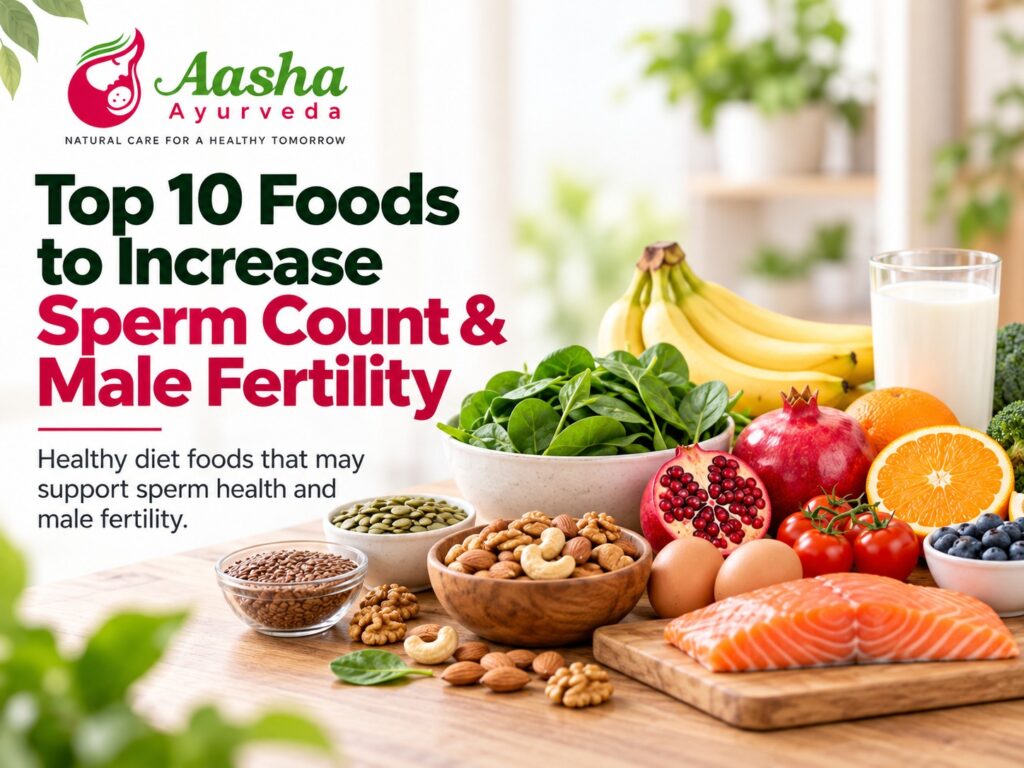
Foods to increase sperm count generally include nuts and seeds, fish rich in omega-3, fruits, vegetables, whole grains, pulses, zinc-rich foods and other minimally processed foods. Research suggests that an overall healthy dietary pattern may be associated with better sperm count, motility and morphology, but no single food can increase sperm count immediately or guarantee pregnancy.
For men trying to conceive, diet should be viewed as one part of male fertility care. Low sperm count can also be related to varicocele, hormonal disorders, testicular conditions, medicines, anabolic steroids, obesity, smoking, alcohol or other causes. WHO specifically lists low sperm levels, abnormal morphology and poor motility among important male infertility factors.
At Aasha Ayurveda, men with an abnormal semen report are encouraged to understand the cause rather than relying only on “sperm-boosting” foods. You can read more about Ayurvedic male infertility treatment at Aasha Ayurveda.
The best foods to increase sperm count are not one “superfood.” A diet rich in nuts, seeds, fruits, vegetables, pulses, whole grains, fish and other nutrient-dense foods is a better approach. Meaningful sperm-production changes also take time because human spermatogenesis itself takes about 74 days.
Can Food Really Increase Sperm Count?
Food can support sperm production and overall reproductive health, but it cannot correct every cause of low sperm count.
A 2025 systematic review of Mediterranean-style dietary patterns found positive associations with sperm count, total motility, progressive motility and morphology, although the studies had substantial variability and did not establish better pregnancy outcomes.
The AUA/ASRM male-infertility guideline also notes that evidence linking specific diets to male fertility remains limited, although diets containing more fruits and vegetables and less high-fat processed food appear preferable for general reproductive health.
This means nutrition matters, but a man with severe oligospermia or azoospermia should not postpone proper evaluation while trying home remedies.
Top 10 Foods to Increase Sperm Count Fast — What Should Men Eat?
The word “fast” needs qualification. These foods may support nutritional status and semen quality over time, but they will not generate a new healthy sperm population within hours or one day.
| Food | Why it may be useful for male fertility | Practical Indian option |
| 1. Walnuts & mixed nuts | Provide unsaturated fats, omega-3, minerals and antioxidants | Walnuts, almonds |
| 2. Pumpkin & sesame seeds | Provide zinc and other minerals | Pumpkin seeds, til |
| 3. Fatty fish | Rich in omega-3 fatty acids | Sardines, salmon, mackerel |
| 4. Tomatoes | Source of lycopene | Tomato sabzi, soup, salad |
| 5. Citrus & vitamin-C-rich fruits | Provide vitamin C and antioxidants | Orange, amla, guava |
| 6. Green leafy vegetables | Folate and micronutrients | Palak, methi |
| 7. Lentils & pulses | Protein, folate, zinc and minerals | Dal, rajma, chana |
| 8. Whole grains | Supports balanced dietary pattern | Oats, whole wheat, brown rice |
| 9. Eggs / lean poultry | High-quality protein and micronutrients | Eggs, chicken where suitable |
| 10. Low-fat dairy / curd | Protein and micronutrients | Dahi, milk, paneer in moderation |
The strongest evidence is for the overall dietary pattern, not for treating a specific semen abnormality with one item.
1. Walnuts and Other Nuts
Walnuts are one of the better-studied foods for semen quality.
In a randomized trial of 117 healthy men, the group consuming 75 g of walnuts daily for 12 weeks showed improvements in sperm vitality, motility and morphology compared with controls, although sperm concentration itself did not significantly change.
A 2024 systematic review found that eating at least around 60 g of nuts daily in the included trials improved motility, vitality and morphology but did not clearly increase sperm concentration.
So walnuts can reasonably be described as a sperm-quality-supporting food, but not as a guaranteed “sperm count medicine.”
2. Sperm Count Increase Food Seeds
For the keyword sperm count increase food seeds, practical choices include:
- pumpkin seeds
- sesame seeds
- sunflower seeds
- flaxseed
- chia seeds
Seeds provide combinations of zinc, magnesium, healthy fats and plant antioxidants.
Zinc is biologically important for normal reproductive function, but simply eating very high amounts does not mean sperm count will keep increasing. Supplements or excessive zinc should not be taken blindly.
A mixed-seed portion can be added to breakfast, curd, oats or salads rather than treating seeds as medicine.
3. Omega-3-Rich Fish
Fatty fish is one of the strongest dietary sources of EPA and DHA omega-3 fatty acids.
A systematic review found that most included studies reported an improvement or positive association between omega-3 intake and at least one semen-quality parameter, although the evidence was heterogeneous.
Another meta-analysis of randomized trials found omega-3 supplementation improved sperm motility but did not significantly improve sperm concentration.
Good options include sardines, salmon and mackerel.
Vegetarians can obtain plant omega-3 from walnuts, flaxseed and chia, although plant ALA is not identical to EPA/DHA from fish.
4. Tomatoes and Lycopene-Rich Foods
Tomatoes contain lycopene, a carotenoid antioxidant.
Research into lycopene and male fertility is promising but not strong enough to claim that tomato alone increases sperm count. A network meta-analysis found potential improvements in sperm concentration and progressive motility with lycopene interventions, but studies of male-fertility interventions vary considerably in quality.
Include tomatoes as part of a varied diet rather than taking highly concentrated products without medical advice.
5. Amla, Guava, Oranges and Other Vitamin-C-Rich Fruits
Vitamin-C-rich fruits fit well into an antioxidant-rich dietary pattern.
Good Indian options include:
amla, guava, oranges, mosambi, kiwi and berries where available.
Antioxidant nutrients have been studied because sperm membranes and DNA may be affected by oxidative stress. However, fruit intake alone has not been proven to treat male infertility.
Choose whole fruit more often than packaged juice because whole fruit provides fibre and usually has less concentrated sugar.
6. Green Leafy Vegetables
Palak, methi and other green vegetables provide folate and a range of micronutrients.
Observational research generally associates diets rich in vegetables and fruits with better semen quality than highly processed dietary patterns.
Aim for variety rather than searching for a single “fertility vegetable.”
7. Lentils, Beans and Pulses
For Indian vegetarians, dal, chana, rajma, lobia and other pulses are particularly useful because they provide:
- protein
- folate
- iron
- zinc
- fibre
These foods help build a nutritionally balanced fertility diet without requiring expensive supplements.
They should not be presented as direct treatments for azoospermia or severe oligospermia.
8. Whole Grains
Whole wheat, oats, barley, millet and brown rice can replace heavily refined carbohydrates in a balanced diet.
Whole grains are repeatedly part of dietary patterns associated with better metabolic and reproductive health.
This is especially relevant because obesity and metabolic health can affect male fertility. WHO lists obesity among lifestyle factors associated with infertility. World Health Organization
9. Eggs and Lean Protein
Eggs provide complete protein along with several micronutrients.
Lean poultry may also fit into a healthy dietary pattern. Observational reviews have associated poultry intake with better semen-quality parameters compared with dietary patterns dominated by processed meats.
There is no established number of eggs that specifically increases sperm count.
The goal should be sufficient high-quality protein within an overall balanced diet.
10. Low-Fat Dairy and Curd
Milk, curd and paneer can provide protein, calcium and other nutrients.
Research on dairy and sperm quality is mixed, and type of dairy may matter. Older observational research has sometimes associated low-fat dairy more favourably than high-fat dairy with semen parameters.
This is another reason not to label one individual food as a fertility cure.
Indian Foods to Increase Sperm Count
For the search indian foods to increase sperm count, there is no need to create an imported “fertility diet.”
A practical Indian male-fertility plate could include dal or chana, mixed vegetables, whole-wheat roti or another whole grain, curd, seasonal fruit and a small portion of nuts or seeds.
Non-vegetarian meals can additionally include eggs or fish.
An easy day might look like:
Breakfast: oats + walnuts + fruit
Lunch: dal + roti + palak + curd
Snack: guava/amla + pumpkin seeds
Dinner: vegetables + rice/roti + fish/egg/pulses
The pattern is more important than one isolated meal.
Veg Foods to Increase Sperm Count
Useful veg foods to increase sperm count and overall semen quality include nuts, seeds, pulses, beans, leafy greens, tomatoes, citrus fruits, amla, guava, whole grains and dairy where tolerated.
A well-planned vegetarian diet can provide most required nutrients.
Men following strict vegan diets should ensure adequate vitamin B12, iodine, iron, zinc, protein and omega-3 intake through appropriately planned foods or clinician-advised supplementation.
Top 5 Foods to Increase Sperm Count
If you want a very short shortlist, choose:
- Nuts, especially walnuts
- Pumpkin and sesame seeds
- Leafy vegetables
- Vitamin-C-rich fruits
- Pulses and beans
For non-vegetarians, omega-3-rich fish can also be a strong addition.
Again, this is a practical food shortlist—not a medical prescription.
Foods to Increase Sperm Count and Motility
Sperm count and motility are different semen parameters.
Count measures the number/concentration of sperm, whereas motility measures how effectively sperm move.
Foods and dietary patterns associated with better motility include nuts and omega-3-rich foods. Randomized nut trials found improvements in motility, while omega-3 studies have also shown potential motility benefits.
If a semen test shows poor motility, read Aasha Ayurveda’s explanation of semen parameters through the normal sperm count and semen-analysis guide rather than interpreting one number in isolation.
Foods to Increase Sperm Count and Quality
“Sperm quality” can refer to several things:
- concentration
- total count
- motility
- morphology
- vitality
- DNA integrity
One food cannot optimize all of them.
Recent Mediterranean-diet research suggests healthier dietary patterns may be associated with better count, motility and morphology, but fertility outcomes such as pregnancy have not been clearly improved by diet alone.
Best Foods to Increase Sperm Count and Quality
Rather than repeatedly changing foods, prioritize these groups over several months:
nuts and seeds + vegetables + fruits + pulses + whole grains + omega-3 sources + adequate protein.
This provides a wider range of antioxidants, fats, minerals and vitamins than taking one “fertility food” every day.
Foods to Increase Sperm Count and Volume
Sperm count and semen volume are not the same.
Sperm cells form only one part of semen. Most semen fluid comes from accessory reproductive glands such as the seminal vesicles and prostate.
A food cannot reliably increase semen volume overnight.
Hydration status and ejaculation frequency can influence measured semen volume, while persistently low volume may sometimes require proper medical evaluation.
Foods to Increase Sperm Count and Stamina
The keyword foods to increase sperm count and stamina combines two separate ideas.
Semen quality and physical/sexual stamina are not interchangeable.
A healthy diet, regular physical activity, adequate sleep and good metabolic health may support overall energy and reproductive wellness, but increasing stamina does not prove that sperm count has increased.
Likewise, a man can have normal sexual performance and still have an abnormal semen analysis.
Foods to Increase Sperm Count and Testosterone
There is no food that reliably raises testosterone enough to treat clinical low testosterone or male infertility.
Adequate nutrition, healthy body weight, sleep and physical activity support normal hormonal health.
However, very low testosterone or symptoms such as reduced libido, erectile problems or severe semen abnormalities need medical evaluation.
An important warning: anabolic steroids and external testosterone can suppress sperm production, which is why fertility planning should be discussed with a clinician. WHO also identifies anabolic steroid use as a cause of abnormal semen parameters. World Health Organization
Foods to Increase Sperm Count and Fertility
Fertility is broader than sperm count.
Pregnancy depends on:
- sperm count
- motility
- morphology
- sperm function
- timing of intercourse
- female reproductive factors
- age and health of both partners
WHO specifically cautions that semen analysis provides useful information but does not by itself prove whether an individual is fertile or infertile.
So “fertility food” should not replace couple-based fertility assessment.
What Foods Produce Sperm Fast?
No food makes the testes produce mature sperm immediately.
Human spermatogenesis itself takes about 74 days, followed by additional maturation after sperm leave the testes.
Sperm-production timeline ≈ 74 days
One day represents:
1 ÷ 74 × 100 ≈ 1.35%
So expecting diet to produce a completely new population of stronger sperm in 1 day is biologically unrealistic.
This is why male-fertility lifestyle interventions are generally better assessed over weeks to months, not overnight.
How to Increase Sperm Count by Food in 1 Day?
You cannot meaningfully increase sperm production through food in one day.
Eating nuts, seeds, fruits or zinc-rich foods today may improve the nutritional quality of your diet, but spermatogenesis occurs over many weeks.
Claims such as:
“Eat this tonight and double sperm count tomorrow”
or
“One banana increases sperm immediately”
are not evidence-based.
Foods to Increase Sperm Count in a Day
The same rule applies to foods to increase sperm count in a day.
Sperm count measured tomorrow may differ naturally from today’s value, but this does not mean one meal created millions of mature new sperm overnight.
Semen analysis also has biological variability, which is why one isolated report should be interpreted alongside history and other findings.
Aasha Ayurveda’s low sperm count treatment and evaluation guide explains why the cause of a low result matters.
Foods to Increase Sperm Count Immediately
There are no foods to increase sperm count immediately.
Diet can support long-term reproductive health, but severe or persistent abnormalities require proper investigation.
This is especially important in men with:
- extremely low sperm concentration
- azoospermia
- testicular pain/swelling
- previous surgery
- varicocele
- hormonal symptoms
How to Increase Sperm Volume Overnight?
There is no reliable food or drink that significantly increases true sperm production overnight.
Do not confuse:
semen volume with sperm count.
A larger ejaculate does not necessarily contain more sperm, and a smaller volume does not automatically mean infertility.
Repeatedly using powders, herbal tonics or excessive fluids only to make semen appear “more” is not a reliable fertility strategy.
Which Type of Banana Increases Sperm Count?
No specific type of banana has been proven to increase sperm count.
Bananas provide carbohydrate, potassium, vitamin B6 and other nutrients, so they can form part of a healthy diet.
But there is no good clinical evidence showing that:
- yellow banana
- red banana
- small banana
- raw banana
has a unique sperm-count-boosting effect.
Choose the variety you enjoy as part of an overall balanced diet rather than treating banana as fertility medicine.
Sperm Count Increases Food Seeds: Which Are Best?
Pumpkin, sesame, sunflower, flax and chia seeds are practical choices.
For male fertility, pumpkin and sesame seeds are particularly useful nutritionally because they contribute zinc and other minerals, while flax/chia provide plant omega-3 fats.
A simple approach is a small mixed-seed portion rather than very large quantities of one seed.
More is not automatically better.
Foods Rich in Zinc to Increase Sperm Count
Zinc is essential for normal male reproductive biology, but a deficiency-focused approach is more sensible than assuming everyone needs high-dose zinc.
Zinc-rich foods include:
- oysters and shellfish
- meat
- pumpkin seeds
- sesame seeds
- chickpeas
- lentils
- dairy
- nuts
Food sources are generally preferable for routine nutrition.
Supplemental zinc should be used thoughtfully because excessive long-term zinc can cause adverse effects and affect copper status.
Foods and Fruits to Increase Sperm Count
Useful fruits include:
amla, guava, oranges, berries, pomegranate, kiwi and other seasonal fruits.
Their main value is providing vitamin C, polyphenols and other micronutrients.
No fruit has been proven to cure low sperm count.
Aim for variety rather than drinking large quantities of sweet fruit juice.
Foods and Drinks to Increase Sperm Count
For drinks, there is no evidence-based “sperm booster drink.”
Prefer:
- water
- milk where suitable
- unsweetened beverages
- whole fruits instead of excessive juices
Limit excessive:
- sugary soft drinks
- alcohol
- very high-calorie beverages
ASRM recommends a healthy diet and lifestyle and advises limiting alcohol while trying to conceive.
Foods and Vitamins to Increase Sperm Count
Nutrients often discussed in male fertility research include:
- zinc
- selenium
- folate
- vitamins C and E
- omega-3 fatty acids
- carnitine
- CoQ10
But nutrient research should not be interpreted as “everyone should take a fertility multivitamin.”
A 2025 systematic review covering 50 randomized trials found no clear improvement in pregnancy or live-birth outcomes from dietary supplements, although individual supplements improved some semen parameters.
That is an important distinction:
better laboratory numbers do not automatically equal pregnancy.
Foods and Supplements to Increase Sperm Count
Supplements may be useful in selected situations, especially where deficiency exists, but evidence is inconsistent.
For example, studies have reported improvements in particular semen parameters with zinc, selenium, carnitine or CoQ10, while evidence quality across male infertility treatments varies.
Before taking multiple antioxidant capsules:
- review your semen analysis
- check current medicines
- identify deficiencies where relevant
- discuss fertility goals
- avoid megadoses
A food-first approach is generally more appropriate than self-prescribing several supplements simultaneously.
Sperm Count Increases Medicine: Is There a Medicine?
There is no universal sperm count increase medicine for every man.
Treatment depends on why the count is low.
A doctor may need to evaluate:
- hormones
- varicocele
- testicular function
- infections
- obstruction
- medicines
- anabolic steroid use
- genetic causes
- lifestyle/metabolic factors
The correct treatment for a hormonal disorder is different from treatment for varicocele or severe testicular failure.
For a fuller explanation, see Aasha Ayurveda’s male infertility treatment page.
Men with no sperm found in semen should not rely on foods or supplements alone; read the dedicated Aasha Ayurveda guide to azoospermia or nil sperm count.
How to Make Sperm Stronger for Pregnancy?
“Strong sperm” is not a laboratory term, but people usually mean sperm with better count, movement and quality.
The practical approach is:
- Eat a nutrient-dense diet.
- Maintain a healthy weight.
- Stop smoking.
- Limit excessive alcohol.
- Avoid recreational drugs and anabolic steroids.
- Exercise regularly without overtraining.
- Sleep adequately.
- Review medicines with a doctor.
- Avoid relying on unproven fertility boosters.
- Get a semen analysis if conception is delayed.
WHO’s current infertility guidance recommends healthy diet, physical activity and tobacco cessation for people planning or attempting pregnancy.
Foods to Avoid to Increase Sperm Count
Rather than treating foods as completely forbidden, reduce dietary patterns dominated by:
- processed meats
- trans-fat-rich foods
- frequent fried foods
- excessive sugary drinks
- excessive alcohol
- highly processed snacks
- very high-calorie diets contributing to obesity
Systematic reviews have associated healthier patterns containing fruits, vegetables, fish, poultry and whole grains with better semen parameters, while some processed-food patterns have been associated with poorer semen quality.
Association does not prove that one food directly caused infertility.
A Simple Indian Male Fertility Diet Plate
A practical plate can be:
½ plate: vegetables/salad
¼ plate: protein such as dal, beans, egg, fish or lean poultry
¼ plate: whole-grain roti, millet, rice or another grain
Add:
- one seasonal fruit
- curd where suitable
- small serving of nuts/seeds
This approach is more sustainable than consuming one “super food to increase sperm count” in large amounts.
When Should You Get a Semen Analysis?
Dietary changes should not delay evaluation when pregnancy has not occurred despite regular unprotected intercourse for around 12 months, or earlier when there is a known male fertility concern. WHO defines infertility based on failure to achieve pregnancy after 12 months or more of regular unprotected intercourse.
Earlier evaluation is reasonable if there is:
- known abnormal semen analysis
- testicular pain/swelling
- azoospermia
- very low sperm count
- sexual/ejaculatory problems
- previous testicular surgery
- cancer treatment history
- hormonal disorder
Semen analysis evaluates sperm concentration, motility, morphology and other semen parameters.
Can Aasha Ayurveda Help With Low Sperm Count?
Aasha Ayurveda approaches male fertility by reviewing the individual’s semen reports, medical history, lifestyle, diet and Ayurvedic assessment rather than prescribing the same diet or medicine to every man.
Ayurvedic care may include physician-guided diet, lifestyle measures and individualized Ayurvedic treatment where appropriate.
However, Ayurveda should not delay urological, hormonal, genetic or reproductive evaluation when a significant medical cause is suspected.
FAQs
Q1. What are the best foods to increase sperm count?
A balanced diet containing nuts, seeds, vegetables, fruits, pulses, whole grains, omega-3-rich fish and adequate protein is a practical approach. No single food is proven to increase sperm count in every man.
Q2. What foods produce sperm fast?
No food produces mature sperm immediately. Human spermatogenesis takes about 74 days, so meaningful biological change should be considered over weeks to months rather than hours.
Q3. Can I increase sperm count by food in 1 day?
No. One day is far too short to produce a completely new population of mature sperm. Eating well today supports long-term nutrition, not an instant laboratory change.
Q4. Which type of banana increases sperm count?
No banana variety has been clinically proven to increase sperm count. Banana can be part of a healthy diet but is not a male infertility treatment.
Q5. What are the best seeds for sperm count?
Pumpkin, sesame, flax, chia and sunflower seeds can provide zinc, healthy fats and micronutrients. Evidence supports the overall diet more strongly than any single seed.
Q6. Can walnuts increase sperm count?
Walnut trials have shown improvements in sperm motility, vitality and morphology, but not consistently in sperm concentration.
Q7. What foods increase sperm count and motility?
Nuts, omega-3-rich foods, fruits, vegetables, pulses and whole grains can form a fertility-supportive diet. Nuts and omega-3 have particularly relevant evidence for motility.
Q8. What foods increase sperm volume overnight?
No food reliably increases sperm production or fertility overnight. Semen volume and sperm count are different measurements.
Q9.What foods increase sperm count immediately?
None. Sperm production takes weeks, and male infertility can have causes that nutrition alone cannot correct.
Q10. Does zinc increase sperm count?
Zinc is important for reproductive health, but supplements do not automatically increase sperm count in every man. Deficiency, diet and the underlying fertility problem matter.
Q11. Are eggs good for sperm?
Eggs are a useful source of high-quality protein and several micronutrients, but they are not proven to independently increase sperm count.
Q12. Is pomegranate good for sperm count?
Pomegranate provides polyphenols and can be part of a healthy diet, but strong human evidence that it independently increases sperm count is insufficient.
Q13. What Indian foods increase sperm count?
Indian options include dal, chana, rajma, palak, methi, tomatoes, amla, guava, citrus fruit, pumpkin seeds, til, walnuts, whole grains, curd, eggs and fish where suitable.
Q14. What medicine increases sperm count?
There is no universal medicine. Treatment depends on the underlying cause, such as hormonal disease, varicocele, testicular problems or another medical factor.
Q15. How can I make sperm stronger for pregnancy?
Focus on balanced nutrition, healthy weight, sleep, exercise, no smoking, minimal alcohol, avoiding anabolic steroids and getting appropriate fertility evaluation when conception is delayed.
About the Author / Ayurvedic Reviewer

Content by: Aasha Ayurveda Editorial Team
Reviewed for Ayurvedic Content By:
Medically Reviewed By: Dr. Chanchal Sharma
Qualifications: MD (AM), BAMS, CGO
Experience: 15+ Years
Last Reviewed: September 2026
Clinic: Aasha Ayurveda
Aasha Ayurveda’s male-infertility page lists Dr. Chanchal Sharma as Director with MD (AM), BAMS, CGO, Panchkarma certification and more than 15 years of experience.
Her fertility-care approach includes review of available semen reports, reproductive history, diet, lifestyle and individualized Ayurvedic assessment.
Medical References
This article was informed by the WHO infertility guidance and semen-analysis manual, AUA/ASRM guidance, recent systematic reviews of Mediterranean-style diets, nuts, omega-3 fatty acids and male-fertility supplements. Current evidence supports healthy dietary patterns, but it does not support promises that one food can immediately raise sperm count or guarantee conception.