
Dominant Follicle in Right Ovary: Meaning, Size & Pregnancy Chances
Written by: Aasha Ayurveda Editorial Team
Medically Reviewed by: Dr. Chanchal Sharma
BAMS, MD (AM), CGO | 15+ Years of Experience
Director – Aasha Ayurveda
Last Medically Reviewed: August 2026
Seeing “dominant follicle in right ovary” on an ultrasound report can raise many questions. Is it normal? Does it mean ovulation is near? What follicle size is good for pregnancy? And does a follicle in the right ovary improve or reduce pregnancy chances?
A dominant follicle is usually the ovarian follicle that has grown more than the others during that menstrual cycle and may eventually release an egg during ovulation.
Having a dominant follicle in the right ovary is generally a normal finding. However, seeing a dominant follicle does not by itself confirm that ovulation has occurred or guarantee pregnancy.
Follicle growth, rupture, fallopian tube health, sperm quality, timing and other fertility factors all matter.
What Does Dominant Follicle in Right Ovary Mean?
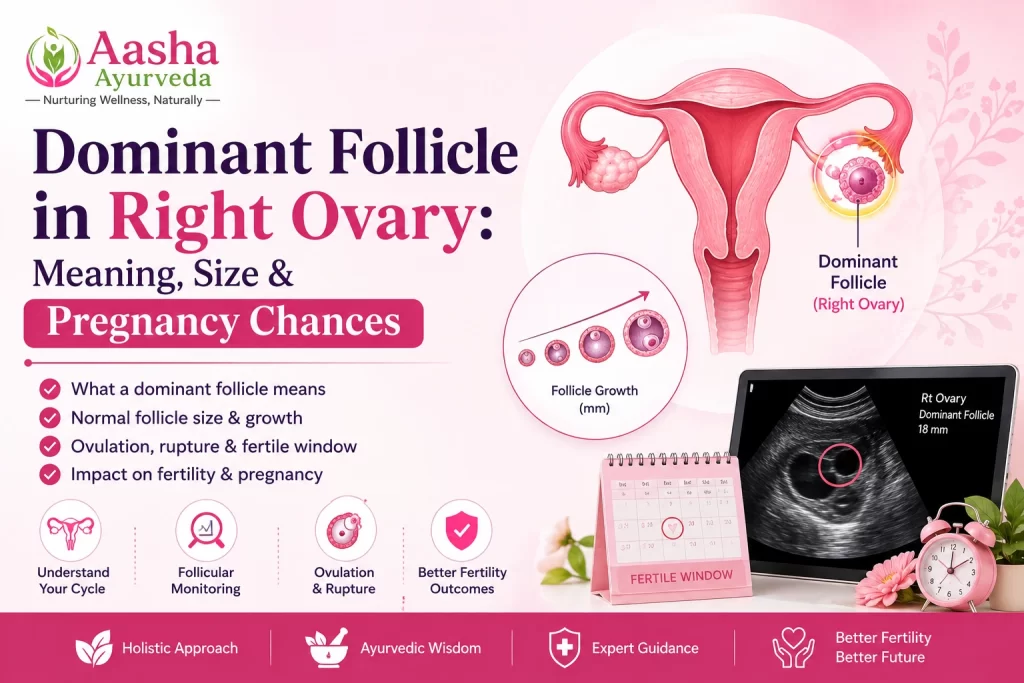
A dominant follicle in the right ovary means that one follicle in your right ovary has become larger than the other developing follicles and may be preparing for ovulation.
In a natural cycle, a dominant follicle commonly grows progressively before ovulation. Follicle size is useful during monitoring, but one ultrasound measurement alone cannot tell exactly when ovulation will happen.
| Question | Quick Answer |
| Is a dominant follicle normal? | Usually yes |
| Can it develop in the right ovary? | Yes |
| Is right ovary better than left? | Side alone does not determine fertility |
| Does a dominant follicle mean ovulation occurred? | No |
| What size is commonly seen near ovulation? | Often around 18–24 mm, with variation |
| Does dominant follicle guarantee pregnancy? | No |
What Is an Ovarian Follicle?
An ovarian follicle is a small fluid-filled structure inside the ovary that contains a developing oocyte or egg cell.
At the beginning of a menstrual cycle, several follicles may start developing. Usually, one becomes more prominent than the others and is selected as the dominant follicle.
The dominant follicle continues growing and produces hormones that support the reproductive cycle.
If normal ovulation occurs, the mature follicle eventually ruptures and releases the egg.
Follicle vs Egg: Are They the Same?
No. A follicle and an egg are not the same thing.
This is an important difference.
Follicle:
The fluid-filled ovarian structure that surrounds and supports the developing egg.
Egg or oocyte:
The reproductive cell present inside the follicle.
During ultrasound monitoring, doctors measure the follicle, not the egg itself.
So if your report says:
“Right ovarian dominant follicle measures 18 mm”
it refers to the size of the follicular structure, not an 18 mm egg.
What Is a Dominant Follicle?
Several small follicles may develop at the beginning of the follicular phase.
Usually one follicle starts growing faster and becomes dominant. Other follicles generally stop progressing.
A dominant follicle is therefore the follicle that is most likely to continue toward ovulation in that cycle.
However:
Dominant follicle → does not automatically mean → successful ovulation
The follicle still needs to mature and rupture for the egg to be released.
What Does a Dominant Follicle in the Right Ovary Mean?
A dominant follicle can develop in:
- the right ovary
- the left ovary
Both are normal.
If your ultrasound shows a dominant follicle in the right ovary, it simply tells you which ovary currently contains the leading follicle.
The ovaries do not have to alternate perfectly every month.
A woman may ovulate from the right ovary in one cycle and again from the right ovary in another cycle.
Is a Dominant Follicle in the Right Ovary Good?
In most cases, seeing a growing dominant follicle is a positive sign that follicular development is taking place.
But whether it is “good for pregnancy” depends on more than its location.
Doctors may also consider:
- follicle size
- follicle growth across serial scans
- evidence of rupture
- endometrial development
- fallopian tube patency
- sperm health
- timing of intercourse or treatment
- age and overall fertility factors
If you are trying to conceive and want to understand the broader factors involved, read about female infertility.
Right Ovary vs Left Ovary: Which Is Better for Pregnancy?
A dominant follicle in either ovary can potentially result in pregnancy.
Some research has observed differences in the frequency of right- and left-sided ovulation, but for an individual woman, the side of the dominant follicle alone should not be used to predict pregnancy success.
The more important questions are:
- Is the follicle developing appropriately?
- Does ovulation occur?
- Is at least one fallopian tube functioning?
- Are other fertility factors favourable?
So:
Right dominant follicle = normal
Left dominant follicle = normal
Neither side automatically guarantees better fertility.
Dominant Follicle Size Chart
Follicles grow progressively during the follicular phase.
The table below gives a general educational interpretation, not a diagnosis.
| Follicle Size | General Interpretation |
| 8–10 mm | Early/developing follicle |
| 11–13 mm | Growing follicle |
| 14–15 mm | Continued follicular development |
| 16–17 mm | Approaching a commonly pre-ovulatory range |
| 18–20 mm | Often considered near maturity |
| 21–22 mm | Commonly within mature/pre-ovulatory range |
| 23–24 mm | May still be pre-ovulatory |
| Above this range | Requires interpretation with cycle timing and scan findings |
Important: Follicle size should not be interpreted in isolation. Natural cycles vary, and serial ultrasound provides more useful information than one number.
What Does a 10 mm Dominant Follicle Mean?
A follicle around 10 mm is generally still developing.
In many natural cycles, a follicle that becomes dominant continues growing over the following days.
A 10 mm measurement does not usually mean that ovulation is immediately about to occur.
A follow-up scan may be recommended when follicular monitoring is being performed.
What Does a 14 mm Dominant Follicle Mean?
A 14 mm dominant follicle usually indicates ongoing follicular growth.
It may continue to enlarge before ovulation.
Whether and when it will rupture cannot be predicted accurately from the 14 mm measurement alone.
Cycle day, growth on previous scans and hormonal context may also matter.
What Does a 16 mm Dominant Follicle Mean?
A 16 mm follicle may be approaching maturity but is not a guarantee that ovulation is happening immediately.
The follicle may continue growing over the following days.
Serial ultrasound is more helpful than making decisions based on a single measurement.
Is an 18 mm Dominant Follicle Mature?
An 18 mm follicle often falls within or close to a commonly observed pre-ovulatory range.
However, this does not mean every 18 mm follicle will rupture immediately.
Doctors may look at:
- growth pattern
- ultrasound appearance
- LH/hormonal changes
- endometrium
- later evidence of follicular collapse
before interpreting the complete picture.
Is a 20 mm Follicle Good for Pregnancy?
A follicle measuring around 20 mm is commonly within a mature or near-mature range in many natural cycles.
But:
20 mm follicle ≠ pregnancy guarantee
The follicle still needs to release an egg, and successful conception also requires several other reproductive factors.
What Does a 22 mm Dominant Follicle Mean?
A 22 mm follicle is commonly within a pre-ovulatory size range.
It may be close to ovulation, but follicle size alone cannot tell the exact hour or day of rupture.
Follow-up ultrasound findings can provide better evidence.
Does a 24 mm Follicle Mean Ovulation Is About to Happen?
A follicle around 24 mm may still be pre-ovulatory in some cycles.
However, there is no universal size at which every follicle ruptures.
Studies have found a wider range of pre-ovulatory follicle sizes, which is why doctors consider multiple findings instead of using one fixed cutoff.
How Fast Does a Dominant Follicle Grow?
In natural, unstimulated cycles, a dominant follicle often grows approximately 1–1.5 mm per day on average, although individual growth varies.
Growth may differ in fertility-treatment cycles.
For example:
14 mm today does not automatically mean 16 mm tomorrow.
It is only an approximate pattern.
Serial follicular monitoring provides the actual growth information for that specific cycle.
How Many Follicles Are Normal in Each Ovary?
The number of small follicles visible on ultrasound varies with:
- age
- menstrual-cycle stage
- ovarian reserve
- hormonal conditions
- fertility medication
The presence of several small follicles is not automatically abnormal.
Similarly, multiple follicles alone do not diagnose PCOS.
Doctors interpret ovarian morphology along with menstrual history, symptoms and other appropriate investigations.
Does a Dominant Follicle Mean Ovulation Will Definitely Happen?
No.
A growing dominant follicle suggests that follicular development is occurring, but it does not guarantee egg release.
The usual sequence is:
Follicle growth → follicle maturity → hormonal signal → follicle rupture → egg release
Occasionally, a follicle may mature but fail to rupture.
Therefore:
Dominant follicle = probable candidate for ovulation
Follicular rupture = stronger evidence that ovulation occurred
What Happens When a Dominant Follicle Ruptures?
When ovulation occurs, the dominant follicle ruptures and releases the egg.
The egg is then picked up by the reproductive tract and may enter a fallopian tube.
After ovulation, the ruptured follicle changes into a structure called the corpus luteum, which produces progesterone and supports the luteal phase.
If fertilization does not occur, hormone levels eventually decline and the next menstrual period begins.
How Is Follicle Rupture Confirmed?
Follicular monitoring using serial transvaginal ultrasound can provide evidence that ovulation has occurred.
After rupture, ultrasound may show changes such as:
- sudden reduction in follicle size
- collapse or disappearance of the follicle
- formation of a corpus luteum
- fluid in the pelvis in an appropriate clinical context
Hormonal information may also be used when clinically appropriate.
One scan before rupture cannot confirm that ovulation eventually happened.
What Happens If the Dominant Follicle Does Not Rupture?
Sometimes a follicle develops but does not release the egg.
This may be described as an unruptured follicle.
A related condition is luteinized unruptured follicle (LUF) syndrome, in which the follicle undergoes luteinization without releasing the egg normally.
Repeated failure of follicular rupture can affect fertility because fertilization requires release of the egg.
One cycle, however, should not automatically be interpreted as a chronic fertility condition.
Dominant Follicle vs Follicular Cyst
A dominant follicle and a follicular cyst are not automatically the same thing.
Dominant Follicle
A normal developing follicle that may eventually ovulate.
Functional Follicular Cyst
A follicle may sometimes persist instead of rupturing and develop into a functional cyst.
Doctors consider:
- size
- appearance
- cycle timing
- symptoms
- persistence on repeat ultrasound
before interpreting whether an ovarian structure is a normal follicle or a functional cyst.
Do not label a follicle as a cyst simply because it is slightly larger than a particular number.
What Is Follicular Monitoring?
Follicular monitoring is a series of ultrasound scans used to observe follicular development during a menstrual cycle.
It may be used in women who:
- are trying to conceive
- have irregular ovulation
- are receiving fertility treatment
- have PCOS
- need timed intercourse or IUI planning
- have unexplained fertility concerns
What Does a Doctor Check During Follicular Monitoring?
Depending on the clinical situation, monitoring may assess:
- right ovarian follicles
- left ovarian follicles
- dominant follicle size
- number of developing follicles
- follicular growth
- endometrial development
- evidence of follicle rupture
- corpus luteum after ovulation
In infertility assessment, ultrasound is only one part of the complete evaluation.
Dominant Follicle and Endometrial Thickness
Follicle development is important for ovulation, but pregnancy requires more than egg release.
The endometrium is the lining inside the uterus where an embryo may implant.
During follicular monitoring, doctors may therefore assess both:
Dominant follicle development + uterine lining
However, one endometrial thickness number alone cannot guarantee or rule out pregnancy.
The full clinical context matters.
Dominant Follicle in Right Ovary and Pregnancy Chances
A dominant follicle in the right ovary can result in pregnancy if the egg is released and the other necessary fertility conditions are favourable.
Conception depends on several steps:
- Follicle develops.
- Egg matures.
- Follicle ruptures.
- Egg enters the reproductive tract.
- Sperm reaches the egg.
- Fertilization occurs.
- Embryo develops.
- Implantation occurs.
So simply seeing a follicle on ultrasound does not provide a percentage chance of pregnancy.
For a broader understanding of conception problems, see Aasha Ayurveda’s infertility treatment resource.
What If the Dominant Follicle Is in the Right Ovary but the Right Fallopian Tube Is Blocked?
This is an important fertility question.
After ovulation, the egg normally needs access to a functioning fallopian tube for natural fertilization.
Therefore, tubal patency is an important fertility factor.
If ultrasound shows a right-sided dominant follicle but you also have a known right-sided tubal blockage, pregnancy chances cannot be judged from the follicle alone.
The type and location of the blockage, condition of the opposite tube and other fertility factors need to be considered.
Read more about fallopian tube blockage treatment and diagnosis.
Can You Get Pregnant If One Fallopian Tube Is Open?
Pregnancy may still be possible with one healthy functioning fallopian tube, depending on the overall reproductive situation.
However, fertility cannot be predicted simply by matching:
right ovary → right tube
or
left ovary → left tube
A fertility specialist should interpret tubal findings together with ovulation and other fertility factors.
Dominant Follicle in PCOS
PCOS can affect normal follicular development and ovulation.
Some women with PCOS may have:
- irregular follicle development
- delayed ovulation
- infrequent ovulation
- anovulatory cycles
- irregular or missed periods
Importantly:
Multiple follicles on an ultrasound do not by themselves diagnose PCOS.
Diagnosis should consider the overall clinical picture.
If you have irregular periods, acne, unwanted facial/body hair or difficulty conceiving, learn more about PCOS treatment.
Can Women With PCOS Develop a Dominant Follicle?
Yes.
Women with PCOS can develop a dominant follicle and ovulate.
However, follicular selection and ovulation may be less predictable in some cycles.
That is why Day-14 assumptions and calendar-only ovulation tracking may not work well when cycles are irregular.
No Dominant Follicle on Ultrasound: Should You Worry?
Not necessarily.
A single scan showing no dominant follicle can have several explanations.
For example:
- the scan may be too early in the cycle
- ovulation may be delayed
- the follicle may have already ruptured depending on timing
- follicular development may be irregular
If serial scans consistently show no appropriate follicular development and ovulation is not occurring, further evaluation may be required.
What Causes Poor Follicular Development?
Several factors can influence ovulation and follicular development, including:
- PCOS
- thyroid dysfunction
- major weight changes
- excessive exercise
- age-related changes
- certain hormonal disorders
- stress in some circumstances
Irregular or absent ovulation deserves evaluation rather than relying on a single ultrasound measurement.
Does Dominant Follicle Size Tell Egg Quality?
No.
Ultrasound can measure a follicle, but follicle diameter is not a direct measurement of egg quality.
A mature-sized follicle does not guarantee:
- chromosomally normal egg
- successful fertilization
- healthy embryo
- implantation
- pregnancy
Age and other reproductive factors are also important.
Does Regular Follicle Growth Guarantee Pregnancy?
No.
Good follicular growth is one part of fertility.
Pregnancy may still be affected by:
- blocked or damaged fallopian tubes
- male infertility
- endometriosis
- uterine factors
- egg-related factors
- ovulation problems
- age
- unexplained infertility
This is why fertility evaluation looks at both partners rather than only the dominant follicle.
When Should You See a Fertility Specialist?
Consider medical evaluation if:
- follicles repeatedly do not mature
- follicles repeatedly fail to rupture
- periods are very irregular or absent
- you have known PCOS
- fallopian tubes may be blocked
- you have endometriosis
- pregnancy is not occurring despite regular attempts
- there is a known male fertility issue
Fertility evaluation may generally be considered after about 12 months of trying when under 35 and around 6 months when 35 or older, with earlier evaluation when known fertility problems are present.
Dr. Chanchal Sharma’s Clinical Perspective
A dominant follicle in the right ovary is usually not something to worry about simply because of its location. During fertility assessment, the more useful information comes from how the follicle grows, whether it ruptures, the menstrual-cycle pattern and whether other reproductive factors are normal.
A single follicle-size measurement should not be used alone to predict ovulation or pregnancy. In women who have irregular cycles, PCOS, tubal blockage or difficulty conceiving, the complete fertility picture needs to be evaluated.
Dr. Chanchal Sharma
BAMS, MD (AM), CGO
Director – Aasha Ayurveda
Please have the final clinical statement reviewed and approved by Dr. Chanchal Sharma before publication.
Frequently Asked Questions
Q1. What does a dominant follicle in the right ovary mean?
It means one follicle in your right ovary has become larger than the others and may be developing toward ovulation.
Q2. Is a dominant follicle in the right ovary good for pregnancy?
It can be a positive sign of follicular development, but it does not guarantee pregnancy. Ovulation, fallopian tubes, sperm health and other reproductive factors also matter.
Q3. What is a normal dominant follicle size?
Dominant follicles grow throughout the follicular phase. Near ovulation, follicles are commonly around the high-teens to low-20-mm range, but individual variation exists and size alone cannot predict ovulation.
Q4. Is an 18 mm follicle mature?
An 18 mm follicle can be close to or within a commonly observed mature/pre-ovulatory range. Follow-up findings are more useful than one measurement alone.
Q5. Is a 20 mm follicle good for pregnancy?
A 20 mm follicle is commonly considered near maturity, but pregnancy cannot be predicted from follicle size alone.
Q6. Can a 14 mm follicle rupture?
A 14 mm follicle may still be developing. Follicles vary, so one size reading cannot reliably predict whether or when rupture will occur.
Q7. How fast does a dominant follicle grow?
In natural cycles, dominant follicles often grow around 1–1.5 mm per day on average, although individual growth varies.
Q8. Does a dominant follicle mean ovulation has happened?
No. A dominant follicle is the leading developing follicle. Ovulation requires follicular rupture and egg release.
Q9. What happens if the dominant follicle does not rupture?
Sometimes a follicle may persist without releasing the egg. Repeated unruptured follicles may require further evaluation.
Q10. Is the right ovary better than the left for pregnancy?
No ovary should be considered universally “better.” A dominant follicle in either ovary can potentially lead to pregnancy.
Q11. Can PCOS have a dominant follicle?
Yes. Women with PCOS can develop a dominant follicle and ovulate, although ovulation may be irregular in some cycles.
Q12. What if the right follicle develops but the right tube is blocked?
Tubal patency is important for natural conception. The situation should be evaluated in the context of the other tube, blockage location and overall fertility factors.
Q13. Does a dominant follicle guarantee pregnancy?
No. Follicular development is only one step in conception.
Q14. How is follicle rupture confirmed?
Serial ultrasound can show changes such as follicle collapse or disappearance and formation of a corpus luteum. Clinical interpretation may also use hormonal information where appropriate.
Key Takeaways
- A dominant follicle in the right ovary is usually a normal finding.
- Follicle and egg are not the same thing.
- A dominant follicle does not confirm successful ovulation.
- Follicles commonly reach the high-teens or low-20-mm range near ovulation, but size varies.
- 18 mm, 20 mm or 22 mm does not guarantee pregnancy or exact ovulation timing.
- Follicular monitoring is more useful than interpreting one ultrasound scan alone.
- Right versus left ovary alone does not determine fertility.
- PCOS can cause irregular follicular development and ovulation.
- Fallopian tube health matters even when a dominant follicle is developing normally.
- Pregnancy depends on ovulation, sperm, tubes, fertilization, embryo development and implantation.
Medical References & Sources
Medical statements in this article should be supported by authoritative and peer-reviewed reproductive-health sources:
- NCBI Bookshelf / StatPearls – Sonography Gynecology Infertility Assessment, Protocols and Interpretation
- WHO – Guideline for the Prevention, Diagnosis and Treatment of Infertility
- American Society for Reproductive Medicine – Fertility Evaluation of Infertile Women
- International Evidence-Based Guideline for the Assessment and Management of PCOS
- RadioGraphics – Normal and Abnormal Appearances of the Ovaries During Assisted Reproduction
- Peer-reviewed research on pre-ovulatory follicular growth and ultrasound monitoring
Medically Reviewed By
Dr. Chanchal Sharma
BAMS, MD (AM), CGO
Director – Aasha Ayurveda
15+ Years of Experience