
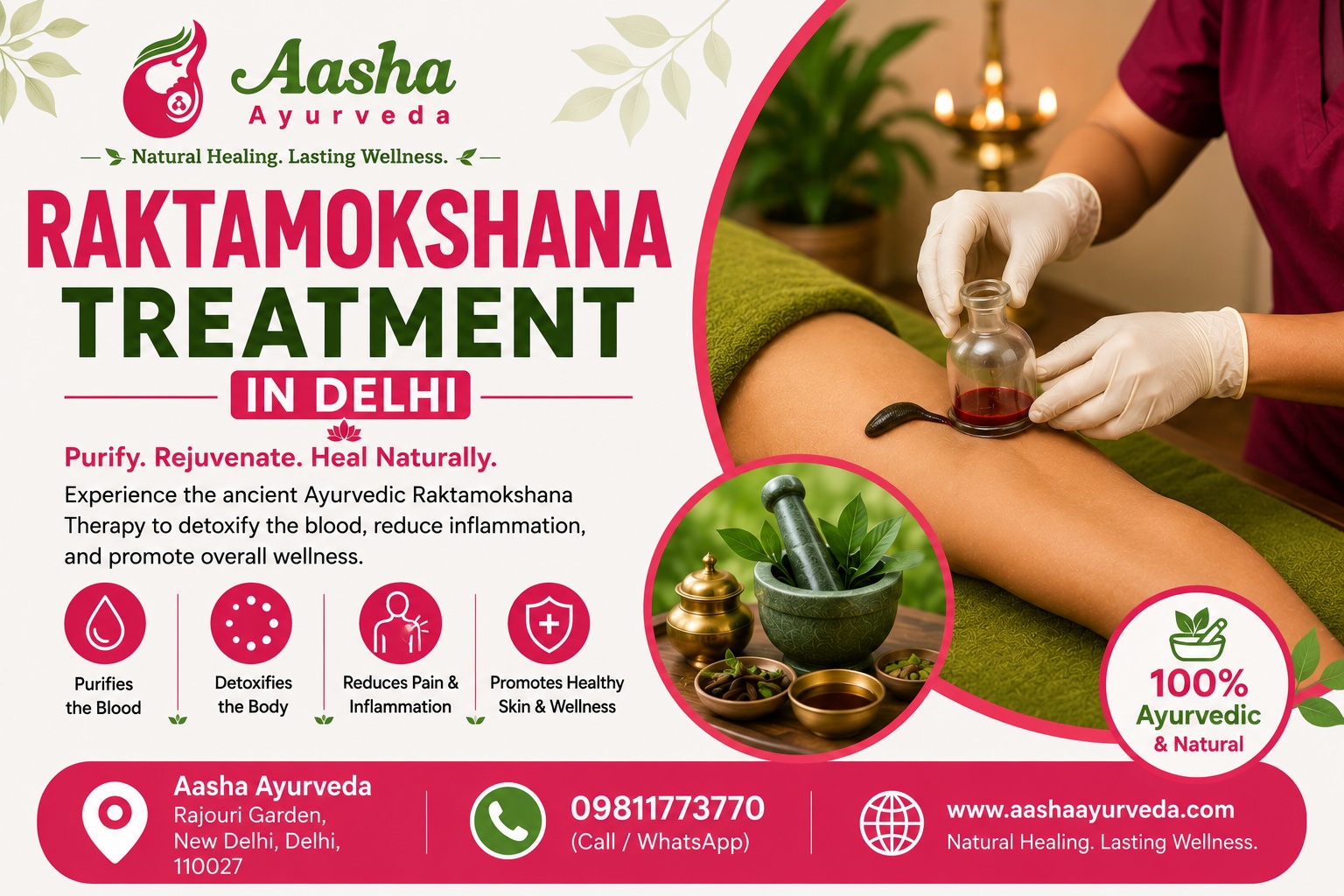
Raktamokshana Treatment in Delhi – Ayurvedic Blood Purification Therapy at Aasha Ayurveda
According to Ayurveda, many chronic skin disorders, inflammatory conditions, and Pitta-related diseases are associated with impurities in the blood (Rakta Dushti). If you are looking for Raktamokshana Treatment in Delhi, Aasha Ayurveda offers authentic Ayurvedic blood purification therapy performed by experienced Ayurvedic doctors following classical Panchakarma principles.
Raktamokshana is one of the specialized purification therapies described in Ayurveda. The treatment focuses on removing vitiated blood (when clinically appropriate according to Ayurvedic practice) to help balance Pitta Dosha, reduce inflammation, support healthy circulation, and promote natural healing. It is traditionally recommended as part of Ayurvedic management for selected conditions such as chronic skin disorders, localized inflammation, gout, varicose vein discomfort, and certain musculoskeletal conditions.
At Aasha Ayurveda, every patient undergoes a detailed consultation before treatment. Our Ayurvedic specialists evaluate your Prakriti (body constitution), Dosha imbalance, medical history, symptoms, and overall health to determine whether Raktamokshana Therapy is suitable for your condition. Patient safety, individualized treatment, and holistic healing remain our highest priorities.
What is Raktamokshana Therapy?
Raktamokshana is a traditional Ayurvedic blood purification therapy aimed at eliminating impure or vitiated blood from specific areas of the body when indicated. In Ayurveda, “Rakta” means blood and “Mokshana” means release or purification.
This therapy is considered an important purification procedure for conditions associated with aggravated Pitta Dosha and blood impurities. By helping remove localized toxins and improving blood circulation, Raktamokshana supports the body’s natural healing process.
Classical Ayurvedic texts describe different techniques of Raktamokshana. The most appropriate method is selected only after a thorough examination by a qualified Ayurvedic doctor. The therapy is performed in a hygienic clinical environment using safe and standardized procedures.
How Raktamokshana Treatment Works
At Aasha Ayurveda, every treatment follows authentic Ayurvedic principles while maintaining high standards of safety and hygiene.
Initial Ayurvedic Consultation
Our experienced Ayurvedic doctors perform a detailed assessment before recommending treatment.
- Medical history – Reviews previous illnesses and current medications.
- Dosha analysis – Identifies Vata, Pitta, and Kapha imbalance.
- Skin and blood assessment – Evaluates the affected condition carefully.
- Overall health evaluation – Determines suitability for therapy.
- Personalized treatment planning – Creates an individualized Ayurvedic protocol.
This consultation ensures that the therapy is both safe and beneficial for the patient.
Preparation Phase
Before the therapy begins, the body may be prepared using supportive Ayurvedic treatments.
- Gentle Abhyanga massage – Relaxes muscles and improves circulation.
- Swedana therapy – Opens body channels through herbal steam.
- Herbal medicines – Supports internal detoxification.
- Clinical examination – Confirms readiness for treatment.
Raktamokshana Procedure
The treatment is performed by experienced Ayurvedic professionals using classical methods appropriate for the patient’s condition.
- Selection of suitable Ayurvedic technique.
- Preparation of the treatment area.
- Controlled purification procedure under medical supervision.
- Continuous patient monitoring throughout the therapy.
- Hygienic and safe clinical practices.
The exact procedure depends entirely on the patient’s diagnosis and Ayurvedic assessment.
Post-Treatment Care
Following the therapy, patients receive comprehensive recovery guidance.
- Wound care instructions if required.
- Personalized Ayurvedic medicines.
- Dietary recommendations to balance Pitta Dosha.
- Lifestyle modifications for long-term wellness.
- Follow-up consultations to monitor healing.
Benefits of Raktamokshana Treatment
Raktamokshana Therapy offers numerous Ayurvedic benefits when performed under expert supervision.
Key Benefits Include:
- Supports natural blood purification.
- Helps reduce excess Pitta Dosha.
- Promotes healthy skin naturally.
- May reduce chronic inflammation.
- Improves blood circulation.
- Supports detoxification of the body.
- Helps manage recurrent skin disorders.
- May relieve localized swelling.
- Supports healthy tissue regeneration.
- Helps reduce burning sensations associated with Pitta imbalance.
- Promotes better wound healing.
- Supports healthy metabolism.
- Encourages overall wellness.
- Improves the body’s natural healing response.
- Complements Panchakarma detoxification programs.
Conditions That May Benefit from Raktamokshana Therapy
Our Ayurvedic doctors may recommend Raktamokshana as part of a personalized treatment plan for selected conditions.
- Psoriasis
- Eczema
- Acne
- Chronic Skin Allergies
- Pigmentation Disorders
- Gout
- Localized Inflammation
- Varicose Vein Discomfort
- Non-Healing Skin Conditions
- Certain Pitta Disorders
- Recurrent Skin Infections
- Boils and Abscesses (Selected Cases)
- Chronic Itching
- Blood Impurity (Rakta Dushti) According to Ayurveda
The suitability of this therapy depends on a complete Ayurvedic consultation and clinical evaluation.
Why Choose Aasha Ayurveda for Raktamokshana Treatment in Delhi?
At Aasha Ayurveda, we combine traditional Ayurvedic wisdom with personalized patient care to provide safe and authentic blood purification therapies.
Why Patients Trust Us
- Experienced Ayurvedic Doctors – Skilled in Panchakarma and purification therapies.
- Personalized Treatment Plans – Tailored according to individual health conditions.
- Authentic Ayurvedic Procedures – Based on classical Ayurvedic principles.
- Hygienic Clinical Environment – Safe and comfortable treatment facilities.
- Comprehensive Health Assessment – Detailed consultation before therapy.
- Premium Ayurvedic Medicines – High-quality herbal formulations.
- Diet & Lifestyle Guidance – Supports long-term healing.
- Regular Follow-Up Care – Continuous monitoring throughout recovery.
- Holistic Healing Approach – Focuses on treating the root cause naturally.
- Patient-Centered Care – Dedicated support at every stage of treatment.
Our integrated Ayurvedic approach aims to improve overall health while promoting safe and sustainable healing.
Who Can Consider Raktamokshana Therapy?
Raktamokshana may be suitable for individuals experiencing:
- Chronic skin disorders.
- Recurrent inflammatory conditions.
- Pitta-related health concerns.
- Persistent acne or skin eruptions.
- Localized swelling.
- Gout-related discomfort.
- Blood impurity according to Ayurvedic diagnosis.
- Chronic itching or skin irritation.
- Patients preparing for comprehensive Panchakarma treatment.
A consultation with our Ayurvedic experts helps determine whether this therapy is appropriate for your condition.
Post-Treatment Care & Lifestyle Recommendations
To achieve the best results after treatment, patients are generally advised to:
- Follow the prescribed Ayurvedic medicines.
- Consume a Pitta-balancing diet.
- Drink sufficient water to maintain hydration.
- Avoid spicy, oily, and processed foods.
- Get adequate rest during recovery.
- Avoid excessive sun exposure if advised.
- Attend follow-up consultations regularly.
- Follow lifestyle recommendations provided by the doctor.
These recommendations support faster healing and long-term health improvement.
Frequently Asked Questions
Q1. Is Raktamokshana Therapy safe?
Yes. When performed by experienced Ayurvedic doctors in a hygienic clinical environment after proper evaluation, Raktamokshana Therapy is generally considered safe for suitable patients.
Q2. Is Raktamokshana part of Panchakarma?
Yes. Raktamokshana is recognized in Ayurveda as a specialized purification therapy and is often included within broader Panchakarma-based treatment approaches depending on the patient’s condition.
Q3. Can Raktamokshana help with skin disorders?
Ayurveda commonly recommends Raktamokshana as part of the management plan for selected chronic skin disorders associated with Rakta Dushti and Pitta imbalance.
Q4. How many sessions are required?
The number of sessions depends on your diagnosis, severity of the condition, and the personalized treatment plan recommended by our Ayurvedic doctors.
Q5 What is the cost of Raktamokshana Treatment in Delhi?
The treatment cost depends on your health condition, the technique used, the number of sessions required, and your overall Panchakarma treatment plan. Our experts provide a personalized estimate after consultation.
Book Raktamokshana Treatment in Delhi
If you are searching for Raktamokshana Treatment in Delhi, Aasha Ayurveda offers authentic Ayurvedic blood purification therapy under the guidance of experienced Panchakarma specialists. Our personalized treatment plans focus on detoxification, balancing Pitta Dosha, improving skin health, and supporting the body’s natural healing process through classical Ayurvedic principles.
Book your consultation today with Aasha Ayurveda and discover a holistic approach to blood purification, skin wellness, and long-term health through authentic Ayurvedic care.
what is Raktmokshan and benefits of Raktmokshan ?
RAKTAMOKSHAN (BLOODLETTING)
WHAT IS RAKTAMOKSHAN?
Susruta was an ancient indian physician. Bloodletting procedure which is well known today in modern science but its root belongs to but not beyond the vedic age. Susrut samhita and ashtangasangraha have dedicated a chapter on this topic. Ashtanga sangrah also mentions about the location of siravedhan according to the disease
Raktamokshan is a procedure applied for treatment of blood borne diseases. Blood in our body runs through artery, veins and capillaries. Vitiated blood is removed through raktamokshan panchakarma therapy.
“सरति याà¤à¤¿à¤ƒ रकà¥à¤¤à¤‚ इति सिराह”
The channels through which blood flows is called sira in ayurveda and puncturing it for letting the blood in out is called siravedhana.
It is a preventive and curative therapy which helps in eliminating toxins from the bloodstreams that is absorbed through the gastro intestinal tract. Dosha pitta has a very close relation with blood. Aggravated pitta may accumulate in blood causing pittaja diseases.
DIFFERENT WAYS OF RAKTAMOKSHAN/BLOODLETTING
Bloodletting can be through use of surgical instrument and without surgical instruments. Few insects are brought in use when the treatment is done without using surgical instruments for blood letting. These are –
shringa (horn), used in vata vitiated blood
alabu (bitter bottle gourd technique) used in kapha vitiated blood
ghati (cupping technique) it drains the vitiated blood settled in different layers of skin
jalauka (leech therapy) used for extracting deep seated blood in pitta vitiated blood.
Most favorable from above is using surgical instruments i.e through siravedhan. Although leech therapy has been into practice in modern science as well.
Basti treatment is considered half or full treatment part of kayachikitsa(medicine branch of ayurveda) in a same way siravedhana is for shalyachikitsa (surgery branch of ayurveda)
CONDITIONS WHERE RAKTAMOKSHAN IS APPLIED
Raktamokshan panchakarma therapy is used to cure the following diseases-
Hypertension
Filarial oedema
Varicosity
Skin disirders
Gout
Tumor
Abscess
Hematuria
Ear diseases
Conjunctivitis
Glaucoma
Liver and spleen disorder
Chronic edema and inflammation
Boils etc and
Diseases caused by vitiated pitta dosha or impure blood.
CONTRAINDICATIONS
Pregnancy, less than 16 years and more than 70 years of age, anemia, piles, tuberculosis, asthma, malnourished, etc and person who have taken only one stage of panchakarma treatment.
MOST FAVORABLE SEASON FOR RAKTAMOKSHAN
Raktamokshan therapy should be done when it is neither too warm nor too cold. Sharad ritu (autumn season) is most suitable for this therapy
RAKTAMOKSHAN PROCEDURE
. Area from where the blood is to be extracted must be mildly oleated and yavagu made of til, tandul and ghrita is fed twice or thrice to the patient. After bloodletting when the impure blood is extracted, patient feels relaxed with less pain and inflammation.
Leech therapy
Leech therapy has shown a positive success graph in patients with psoriasis, pain disorders and other skin diseases. Twelve types of leeches are known. Of which 6 are poisonous and 6 are non poisonous. Those that are non poisonous are used in leech therapy.
After local swedana (fomentation) leeches are applied on the area from where blood need to be extracted. After all the impure blood is out leeches automatically leave the site. If done properly symptoms are same as above.
On completion of the therapy antiseptic is applied with dressing and gentle massage with a medicated oil.
COMPLICATIONS
Raktamokshan if not done appropriately results in certain complications such as itching, inflammation, pain and hardness on the site of blood letting. If raktamokshan therapy is done more than required it may lead to weakness and headache. To avoid excessive bleeding raktastambhan drugs like paste of shalmali (Salmalia malabarica) and upodika (Nigella rubra) is used.
For raktamokshan panchakarma therapy one must make sure to choose the right practitioner for themselves. Those seeking this particular therapy may stop their further search in Aasha ayurvedic centre located in Delhi.