
Egg Freezing Procedure in India
Egg Freezing Procedure in India: Steps, Cost, Best Age, Success & Risks
Dr. Chanchal Sharma – Director, Aasha Ayurveda
- Qualifications: MD (AM), BAMS, CGO
- Experience: 15+ Years
- Additional Credentials: Certified in Panchkarma, MSc (Biotech), DNHE
- Area of Focus: Ayurveda, women’s reproductive wellness and fertility-supportive care
- Organization: Aasha Ayurveda
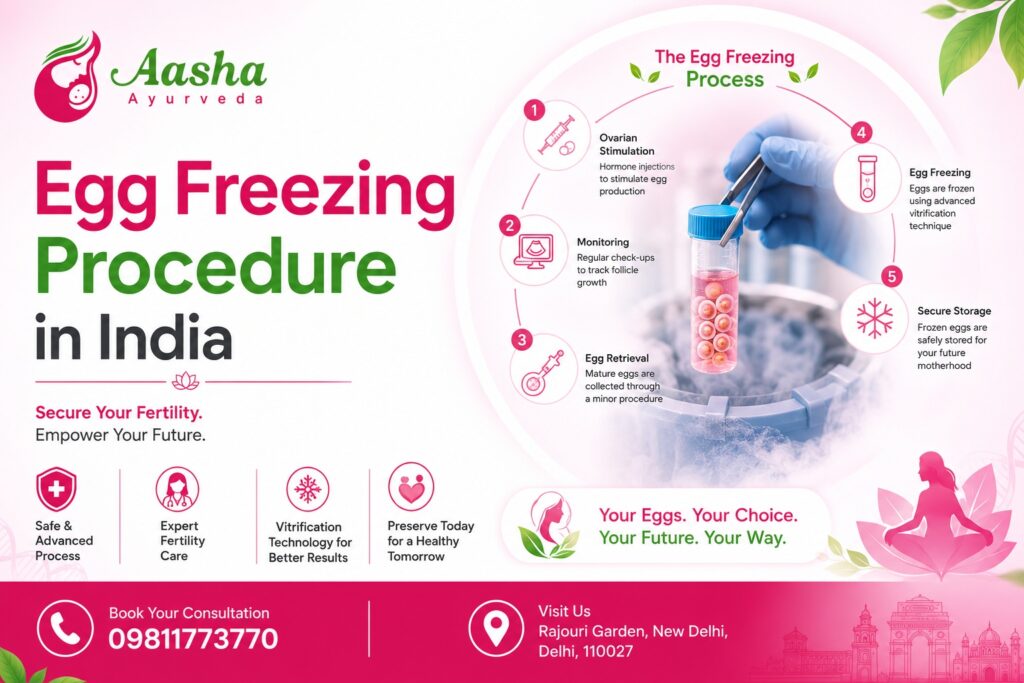
Egg freezing, medically known as oocyte cryopreservation, is a fertility-preservation procedure in which mature unfertilized eggs are collected from the ovaries, rapidly frozen using a technique called vitrification, and stored for possible future use. The egg freezing procedure in India generally involves fertility testing, about 8–14 days of ovarian stimulation and monitoring, egg retrieval, vitrification, and cryogenic storage. Egg freezing may preserve future reproductive options, but it does not guarantee pregnancy or live birth.
Egg Freezing at a Glance
| Question | Quick Answer |
| What is egg freezing? | Freezing and storing mature unfertilized eggs for possible future use |
| Medical term | Oocyte cryopreservation |
| Main technique | Vitrification |
| Ovarian stimulation | Commonly around 8–14 days; varies individually |
| Egg retrieval | Usually a short, ultrasound-guided procedure under sedation/anesthesia |
| Overall process | Consultation → Tests → Stimulation → Monitoring → Trigger → Retrieval → Vitrification → Storage |
| Broad India cost estimate | Approximately ₹1 lakh–₹2.5 lakh+ per cycle; inclusions vary |
| Best timing principle | Younger eggs generally have greater reproductive potential |
| Does it guarantee pregnancy? | No |
| How are eggs used later? | Warming → Fertilization, commonly via ICSI → Embryo development → Transfer |
| Storage | Subject to applicable regulations, consent terms and clinic policies |
Important: Costs, treatment protocols, storage rules and expected outcomes vary. Obtain individualized advice and current information from a qualified, appropriately registered fertility/ART clinic.
What Is Egg Freezing?
Egg freezing is a medical fertility-preservation technique in which mature eggs—called oocytes—are retrieved from a woman’s ovaries and cryopreserved for potential reproductive use in the future.
Unlike embryo freezing, eggs are stored before fertilization, so sperm is not required at the time of freezing.
If a woman later chooses to use her frozen eggs, the eggs are warmed in an embryology laboratory. Eggs that survive warming and are suitable for treatment are generally fertilized through assisted reproduction, commonly using ICSI (Intracytoplasmic Sperm Injection).
If fertilization and embryo development occur successfully, a suitable embryo may later be transferred to the uterus.
How Does Egg Freezing Work?
The process generally follows this pathway:
Fertility consultation → Ovarian reserve testing → Ovarian stimulation → Follicular monitoring → Trigger medication → Egg retrieval → Mature egg assessment → Vitrification → Cryogenic storage
When the eggs are needed:
Egg warming → Fertilization → Embryo culture → Embryo transfer
Egg freezing preserves eggs at approximately the biological age at which they were retrieved. However, it does not stop the woman’s body from aging, and age at the time of future pregnancy can still affect maternal and pregnancy-related health risks.
Medical citation recommended: Add an authoritative reproductive-medicine source supporting age-related fertility decline and oocyte cryopreservation principles.
Why Do Women Consider Freezing Their Eggs?
Women consider freezing eggs for many personal and medical reasons.
Delaying Pregnancy
Some women may not be ready for pregnancy because of:
- Career or education
- Financial planning
- Personal circumstances
- Not having found the right partner
- Not feeling ready for parenthood
Egg freezing may provide an additional reproductive option, but it should not be viewed as an insurance policy that guarantees a future baby.
Age-Related Fertility Decline
Female fertility generally declines with age because both the number of remaining eggs and the proportion of eggs with normal reproductive potential change over time.
Age at egg retrieval is therefore one of the most important considerations when discussing elective egg freezing.
Medical citation recommended: Cite an authoritative guideline or peer-reviewed source on female age and fertility.
Cancer Treatment
Certain cancer treatments, including some forms of chemotherapy, radiotherapy or surgery, may affect ovarian function.
When medically appropriate, fertility preservation may be discussed before treatment begins.
These decisions require coordination between the treating oncologist and a fertility specialist.
Medical Conditions That May Affect Fertility
Egg freezing may sometimes be considered for women with:
- Certain cases of endometriosis
- Planned ovarian surgery
- Risk of premature ovarian insufficiency
- Certain genetic conditions
- Medical treatments that may affect ovarian function
The decision must be individualized according to diagnosis, age, ovarian reserve and future reproductive plans.
Who Should Consider Egg Freezing?
You may benefit from discussing fertility preservation with a specialist if:
- You expect to delay pregnancy for several years.
- You are concerned about age-related fertility decline.
- You are facing medical treatment that could affect fertility.
- You have a condition that may affect ovarian reserve.
- You are planning ovarian surgery.
- You have a family or medical history associated with earlier loss of ovarian function.
- You want to understand your reproductive options before making long-term family-planning decisions.
Egg freezing is not automatically necessary for every woman who plans to delay pregnancy.
A specialist may consider:
- Age
- AMH
- Antral Follicle Count (AFC)
- Menstrual history
- Medical history
- Expected ovarian response
- Desired number of future children
- Personal timeline
Egg Freezing by Age
Age is one of the most important factors affecting the reproductive potential of frozen eggs.
| Age | General Consideration | What to Discuss |
| Under 30 | Younger eggs generally have higher reproductive potential | Whether freezing this early is necessary based on personal circumstances |
| 30–34 | Often a useful period to assess fertility-preservation options | AMH, AFC, family timeline and expected egg yield |
| 35–37 | Age-related fertility decline becomes increasingly relevant | Number of mature eggs expected and whether more than one cycle may be needed |
| 38–40 | Outcomes become more individualized | Ovarian reserve, realistic expectations and possible multiple cycles |
| 40+ | Reproductive potential of newly retrieved eggs is generally lower | Expected benefit, alternatives and realistic probability of success |
This table is intended as general educational guidance—not an individualized prediction of pregnancy or live birth.
What Is the Best Age to Freeze Eggs?
There is no single “best age” that applies to every woman.
Biologically, freezing eggs at a younger age generally offers an advantage because egg quality is strongly related to age. However, freezing very early can also mean undergoing and paying for a procedure and long-term storage for eggs that may never be needed.
The decision should balance:
- Biological age
- Ovarian reserve
- Personal timeline
- Future family goals
- Financial considerations
- Likelihood of using the frozen eggs
Women in their 30s who expect to delay pregnancy may particularly benefit from discussing their individual situation with a fertility specialist rather than waiting until fertility has declined substantially.
Can Eggs Be Frozen After 40?
Egg retrieval and freezing may still be technically possible in selected women after 40, but age-related changes can significantly affect the reproductive potential of the eggs obtained.
A specialist should discuss realistic expectations based on AMH, AFC, ovarian response, age and reproductive goals.
Considering Egg Freezing?
If you are delaying pregnancy or concerned about your reproductive health, obtain an individualized fertility assessment rather than relying only on age or an online ovarian-reserve calculator.
For complementary preconception and reproductive-wellness support, Aasha Ayurveda can provide personalized lifestyle and wellness guidance alongside appropriate evaluation by your gynecologist or fertility specialist.
How to Freeze Eggs in Women: Step-by-Step Egg Freezing Procedure in India
Egg freezing cannot be performed at home.
It is a specialized medical and laboratory procedure that must be carried out through an appropriately qualified fertility/ART facility.
Here is how the egg freezing procedure in India generally works.
Step 1: Consultation With a Fertility Specialist
The process begins with a detailed consultation.
Your doctor may review:
- Age
- Menstrual cycles
- Pregnancy history
- Fertility history
- Previous surgeries
- Medical conditions
- Current medications
- Family history
- Future family goals
The aim is to determine whether egg freezing is appropriate and to set realistic expectations.
Step 2: Fertility and Ovarian Reserve Assessment
Tests help estimate how the ovaries may respond to stimulation.
| Test | What It Helps Assess |
| AMH | Ovarian reserve and expected response to stimulation |
| AFC | Number of small antral follicles visible on ultrasound |
| Pelvic Ultrasound | Ovaries, uterus, follicles and relevant abnormalities |
| Hormone Tests | Reproductive/endocrine factors when clinically indicated |
AMH Test
Anti-Müllerian Hormone is commonly used as a marker related to ovarian reserve and expected response to ovarian stimulation.
AMH does not directly measure egg quality, nor can it tell a woman whether she will or will not become pregnant naturally.
Medical citation recommended: Add a guideline/source supporting appropriate interpretation of AMH.
Antral Follicle Count
AFC is assessed by ultrasound and counts visible small follicles within the ovaries.
AMH and AFC are often interpreted together with age and clinical history.
Step 3: Ovarian Stimulation
In a natural menstrual cycle, usually one follicle becomes dominant.
During egg freezing, prescription hormonal medications are used to encourage multiple follicles to develop during the same treatment cycle.
The:
- Medication type
- Dose
- Protocol
- Duration
are individualized.
Ovarian stimulation commonly lasts approximately 8–14 days, although treatment varies from person to person.
Never use fertility hormones without specialist supervision.
Step 4: Follicular Monitoring
During stimulation, the fertility team monitors ovarian response through:
- Ultrasound scans
- Follicle measurements
- Blood tests when clinically indicated
Medication may be adjusted according to response.
Monitoring helps the specialist determine when follicles are ready for final maturation.
Step 5: Trigger Medication
When follicles reach an appropriate developmental stage, a trigger medication is given to support final egg maturation.
Timing is important because egg retrieval is scheduled within a specific interval afterward.
Patients should follow clinic instructions precisely.
Step 6: Egg Retrieval
Egg retrieval is usually performed using transvaginal ultrasound guidance.
A needle is guided to the ovarian follicles and follicular fluid is collected.
Sedation or anesthesia is commonly used.
The procedure often takes approximately 15–30 minutes, although this varies.
Most patients are monitored afterward and can return home the same day when medically stable.
Is Egg Retrieval Painful?
Because sedation or anesthesia is commonly used, significant pain during retrieval is usually minimized.
Temporary symptoms afterward may include:
- Mild cramps
- Bloating
- Pelvic discomfort
- Light spotting
- Fatigue
Severe or worsening symptoms require medical assessment.
Step 7: Laboratory Assessment
One important point often overlooked is:
Number of follicles ≠ number of eggs retrieved ≠ number of mature eggs frozen.
Not every follicle contains an egg, and not every retrieved egg is mature enough for cryopreservation.
Embryologists assess the retrieved eggs and identify those suitable for freezing.
Step 8: How Do Eggs Freeze? Understanding Vitrification
Modern egg freezing commonly uses vitrification, an ultra-rapid cryopreservation technique designed to minimize damaging ice-crystal formation.
Suitable mature eggs are processed according to specialized laboratory protocols and stored at extremely low temperatures.
Vitrification must be performed by trained embryology professionals in specialized ART laboratories.
Medical citation recommended: Add a peer-reviewed or professional reproductive-medicine source on vitrification.
Step 9: Cryogenic Storage
Frozen eggs are stored under controlled cryogenic conditions with systems for:
- Patient identification
- Traceability
- Consent
- Record keeping
- Storage monitoring
Storage duration is governed by applicable laws, regulations, consent arrangements and clinic policies.
Step 10: Using Frozen Eggs Later
When a woman decides to use her eggs:
Warming → Assessment → Fertilization → Embryo Culture → Embryo Transfer
Fertilization is commonly performed using ICSI.
Not every egg will necessarily:
- Survive warming
- Fertilize
- Develop into a viable embryo
- Implant after transfer
- Result in live birth
This biological attrition is why storing eggs does not guarantee a future child.
Egg Freezing Timeline
| Stage | Approximate Timing |
| Consultation & Tests | Before treatment cycle |
| Ovarian Stimulation | Commonly around 8–14 days |
| Monitoring | During stimulation |
| Trigger | Timed before retrieval |
| Egg Retrieval | Usually one procedure day |
| Laboratory Assessment & Vitrification | After retrieval |
| Recovery | Usually short; individual variation |
| Storage | According to regulations and consent |
The stimulation and retrieval phase can often be completed within one treatment cycle, although initial testing and planning may extend the overall timeline.
How Many Eggs Should You Freeze?
There is no universal number of eggs that guarantees a baby.
The number of mature eggs a specialist may recommend trying to store depends on:
- Age at freezing
- Ovarian reserve
- Expected response
- Desired number of future children
- Number of mature eggs obtained
- Expected egg survival after warming
- Fertilization
- Embryo development
Because reproductive potential declines with age, an older patient may need to discuss storing more eggs or undergoing multiple retrieval cycles to reach a particular estimated probability of future success.
Any numerical estimate should be individualized rather than presented as a guarantee.
Will I Need More Than One Egg-Freezing Cycle?
Possibly.
Multiple cycles may be considered when:
- Few mature eggs are obtained
- Ovarian reserve is lower
- Ovarian response is limited
- Age affects expected reproductive potential
- More than one future child is desired
A decision about another cycle is best made after reviewing the actual results of the first retrieval.
Egg Freezing Cost in India
The egg freezing cost in India varies substantially depending on the clinic, city, medications, ovarian response, number of cycles, laboratory charges and storage policy.
A broad market estimate for one treatment cycle may be approximately ₹1 lakh to ₹2.5 lakh or more, but this should not be interpreted as a fixed national price.
Egg Freezing Cost Breakdown
| Cost Component | Usually Part of Treatment? | Possible Extra Cost? |
| Initial Consultation | Often | Depends on clinic |
| AMH & Fertility Tests | Sometimes | Often separate |
| Ultrasound Monitoring | Often | Additional scans may vary |
| Hormonal Injections | Variable | Frequently a significant separate expense |
| Egg Retrieval | Usually | Check procedure package |
| Sedation/Anesthesia | Variable | May be separately billed |
| Embryology/Lab Charges | Usually | Depends on package |
| Vitrification | Usually | Confirm number of eggs included |
| Initial Storage | Sometimes | Confirm included period |
| Annual Storage | Usually separate | Recurring charge |
| Future Egg Warming | No | Additional future cost |
| ICSI/IVF | No | Additional future cost |
| Embryo Transfer | No | Additional future cost |
Cost information last reviewed: 2026. Actual charges vary and should be confirmed directly with the treating clinic.
What Affects Egg Freezing Cost?
Medication Requirements
Medication costs vary depending on ovarian reserve and response.
Number of Cycles
If more than one retrieval is required, total cost increases substantially.
Storage
Initial storage may or may not be included. Long-term storage commonly involves recurring charges.
Future Fertility Treatment
The original egg-freezing fee usually does not cover all future costs of warming, ICSI, embryo culture and embryo transfer.
City and Clinic
Prices differ between Delhi, Mumbai, Bangalore, Hyderabad, Chennai, Pune and other locations.
Rather than relying on generic city averages, obtain a written itemized quote.
Egg Freezing Success Rate: Understanding What “Success” Really Means
A single percentage can be misleading.
“Egg freezing success rate” may refer to completely different outcomes.
The Egg-to-Live-Birth Pathway
Follicles → Eggs Retrieved → Mature Eggs Frozen → Eggs Warmed → Eggs Survive → Fertilization → Embryos Develop → Embryo Transfer → Implantation → Clinical Pregnancy → Live Birth
Each step involves some biological attrition.
Different Types of Success Rates
| Term | What It Actually Measures |
| Egg Survival Rate | Percentage of warmed eggs that survive |
| Fertilization Rate | Percentage of suitable warmed eggs that fertilize |
| Blastocyst/Embryo Development | Percentage progressing to a specified developmental stage |
| Clinical Pregnancy Rate | Pregnancies meeting a defined clinical criterion |
| Live-Birth Rate | Treatments resulting in a live birth |
These percentages are not interchangeable.
For example, a high egg-survival rate does not mean the same percentage of women will have a baby.
What Determines Future Success?
Important factors include:
- Age when eggs were frozen
- Number of mature eggs stored
- Egg quality
- Laboratory expertise
- Warming outcomes
- Sperm factors
- Fertilization
- Embryo development
- Uterine health
- Maternal age and health at pregnancy
If numerical success rates are published, they should clearly define the outcome measured and be supported by a reliable clinical source.
Does Egg Freezing Guarantee Pregnancy?
No.
Egg freezing preserves a reproductive opportunity; it does not guarantee pregnancy or live birth.
This distinction should be clearly explained during informed consent.
Risks and Side Effects of Egg Freezing
Egg freezing is an established fertility-preservation procedure, but it is not risk-free.
Common Temporary Effects
Ovarian stimulation may cause:
- Bloating
- Pelvic heaviness
- Injection-site discomfort
- Headache
- Breast tenderness
- Fatigue
- Mood changes
Ovarian Hyperstimulation Syndrome (OHSS)
OHSS is an excessive response to ovarian-stimulation medications.
Modern individualized protocols and monitoring can reduce risk, but patients should understand warning symptoms and follow clinic instructions.
Medical citation recommended: Add a recognized clinical guideline on OHSS.
Egg Retrieval Risks
Uncommon complications include:
- Bleeding
- Infection
- Injury to nearby structures
- Sedation/anesthesia-related complications
Ovarian Torsion
Rarely, enlarged stimulated ovaries may twist.
Sudden severe pelvic pain—particularly with nausea or vomiting—requires urgent medical evaluation.
Is Egg Freezing Safe?
Available evidence supports egg freezing as an established fertility-preservation method, but no medical procedure can be described as completely risk-free.
For the Woman
Most short-term risks relate to ovarian stimulation, retrieval and sedation/anesthesia.
For the Eggs
Not every cryopreserved egg survives warming or retains developmental potential.
For Future Children
Available research on children conceived from vitrified oocytes has generally been reassuring, although medical evidence continues to evolve.
Medical citation recommended: Add an authoritative systematic review or professional guideline supporting safety statements.
How Long Can Frozen Eggs Be Stored in India?
Eggs stored under appropriate cryogenic conditions do not undergo normal biological aging in the way eggs remaining in the ovaries do.
However:
Biological storage capability ≠ legally permitted storage duration.
In India, storage duration and procedures are governed by applicable ART legislation, regulations, consent requirements and clinic policies.
Because legal requirements can change, avoid relying on an old claim such as “eggs can only be stored for exactly 10 years.”
Patients should ask their registered ART clinic:
- What is the current legally permitted storage period?
- How often must consent be renewed?
- What are annual storage fees?
- What happens if fees are not paid?
- What are the rules for continued storage, use, transfer or disposal?
Regulatory citation required before publication: Link the current official Indian government/ART regulatory source supporting the storage rules described on the page.
Egg Freezing Rules and Legal Considerations in India
Before undergoing treatment, verify that the facility complies with current Indian ART regulations.
Important areas include:
- ART clinic registration
- Informed consent
- Patient confidentiality
- Record keeping
- Identification and traceability
- Cryostorage
- Storage duration
- Renewal and disposal policies
- Applicable eligibility requirements
Legal and regulatory information should be reviewed periodically because rules may change.
Egg Freezing vs Embryo Freezing
| Factor | Egg Freezing | Embryo Freezing |
| What Is Frozen? | Unfertilized mature eggs | Fertilized embryos |
| Sperm Required Now? | No | Yes |
| Fertilization | Happens later | Happens before freezing |
| Common Purpose | Fertility preservation | IVF/future embryo transfer |
| Future Steps | Warming → Fertilization → Embryo culture → Transfer | Warming → Embryo transfer when appropriate |
| Reproductive Decision | Sperm source not required at freezing | Fertilization decisions made before freezing |
Egg Freezing vs IVF
The early stages can look similar because both may involve:
- Ovarian stimulation
- Follicular monitoring
- Trigger medication
- Egg retrieval
The key difference comes after retrieval.
Egg freezing: Mature unfertilized eggs are vitrified for potential future use.
IVF: Eggs are fertilized with sperm to create embryos as part of fertility treatment.
Myths and Facts About Egg Freezing
Myth: Egg freezing guarantees a baby later.
Fact: It cannot guarantee pregnancy or live birth.
Myth: Frozen eggs lose quality every year in storage.
Fact: Properly cryopreserved eggs do not undergo normal biological aging during storage, although not every egg survives warming or develops into a viable embryo.
Myth: Egg freezing is only for unmarried women.
Fact: Fertility-preservation decisions depend on reproductive and medical circumstances, subject to applicable laws and clinical criteria.
Myth: Egg retrieval removes all the eggs from your ovaries.
Fact: Retrieval collects eggs from follicles recruited during that treatment cycle; it does not remove the entire ovarian reserve.
Myth: Egg freezing causes early menopause.
Fact: Standard ovarian stimulation recruits follicles from a cohort already developing during that cycle and is not understood to exhaust the entire ovarian reserve.
Myth: Egg freezing works equally well at every age.
Fact: Age at retrieval strongly influences reproductive potential.
How to Prepare for Egg Freezing
General preparation may include:
- Completing recommended tests
- Sharing all medications and supplements with your doctor
- Avoiding smoking and tobacco
- Following a balanced diet
- Getting adequate sleep
- Limiting alcohol
- Attending every monitoring appointment
- Following medication timing precisely
- Arranging transport after retrieval if sedation is used
Do not begin unprescribed fertility hormones, supplements or herbal medicines without discussing them with your treating specialist.
What Happens After Egg Retrieval?
Temporary symptoms can include:
- Mild cramps
- Bloating
- Light spotting
- Fatigue
Follow the clinic’s instructions regarding:
- Exercise
- Sexual activity
- Travel
- Medication
- Return to work
Seek urgent medical advice for severe pain, heavy bleeding, difficulty breathing, fainting, persistent vomiting, rapidly worsening abdominal swelling or fever.
Can You Get Pregnant Naturally After Freezing Eggs?
Yes.
Egg freezing generally does not prevent future natural conception.
Some women later conceive naturally and never use their frozen eggs.
The stored eggs should therefore be viewed as an additional reproductive option—not a guarantee and not necessarily the only way to conceive later.
Fertility and Preconception Wellness at Aasha Ayurveda
At Aasha Ayurveda, reproductive wellness is approached by considering nutrition, menstrual health, lifestyle, sleep, stress and overall well-being.
Personalized complementary support may focus on:
- Preconception wellness
- Balanced nutrition
- Healthy lifestyle habits
- Menstrual wellness
- Stress management
- Sleep
- PCOS-related lifestyle support
- General reproductive well-being
Important distinction: Egg retrieval, vitrification, cryogenic storage, IVF and ICSI are specialized medical ART procedures and must be performed at appropriately qualified and regulated fertility facilities.
Aasha Ayurveda’s complementary wellness support should not replace necessary gynecological evaluation, fertility treatment or ART procedures.
Looking for personalized preconception and reproductive wellness support? Consult Aasha Ayurveda while continuing appropriate evaluation and treatment with your gynecologist or fertility specialist.
Frequently Asked Questions
Q1. What is egg freezing?
Egg freezing, or oocyte cryopreservation, is a fertility-preservation procedure in which mature unfertilized eggs are retrieved, vitrified and stored for possible future reproductive use.
Q2. How long does the egg freezing procedure take?
Ovarian stimulation commonly lasts around 8–14 days, followed by egg retrieval. Including consultation, testing and cycle planning, the full process may take several weeks.
Q3. Is egg freezing painful?
Hormonal injections can cause temporary discomfort, while retrieval is generally performed with sedation or anesthesia. Mild cramps, bloating or spotting may occur afterward.
Q4. How much does egg freezing cost in India?
A broad estimate is approximately ₹1 lakh–₹2.5 lakh or more per cycle, but medicines, storage and future IVF/ICSI may cost extra. Always obtain an itemized clinic quote.
Q5. Does egg freezing guarantee pregnancy?
No. Future success depends on age at freezing, number and quality of mature eggs, warming, fertilization, embryo development, implantation and other fertility factors.
Q6. Can eggs be frozen after age 40?
It may be possible in selected cases, but the reproductive potential of eggs retrieved at older ages is generally lower. Individualized counseling is essential.
Q7. How many eggs should I freeze?
There is no universal number. Recommendations depend on age, ovarian reserve, desired family size and expected attrition from warming through potential live birth.
Q8. Do all frozen eggs survive warming?
No. Modern vitrification can achieve high survival in experienced laboratories, but survival is not 100%.
Q9. Can I get pregnant naturally after freezing my eggs?
Yes. Egg freezing itself generally does not prevent natural conception, and some women never need to use their stored eggs.
Q10. How long can frozen eggs be stored in India?
Storage is subject to current Indian ART regulations, consent requirements and clinic policies. Verify the current legally permitted duration directly with a registered ART clinic.
Conclusion
The egg freezing procedure in India generally involves fertility assessment, controlled ovarian stimulation, monitoring, trigger medication, egg retrieval, laboratory assessment, vitrification and cryogenic storage.
For women considering freezing eggs, the most important factors are not simply whether the technology is available or how much it costs.
Consider:
- Your age when the eggs will be frozen
- Ovarian reserve
- Expected mature egg yield
- Possibility of needing multiple cycles
- Total treatment and storage cost
- Clinic and embryology-laboratory quality
- Future fertilization and IVF/ICSI requirements
- Realistic probability of future live birth
Egg freezing can preserve reproductive options, but it cannot guarantee a future pregnancy or baby.
Before making a decision, consult a qualified fertility specialist who can provide individualized estimates based on your age, AMH, AFC and reproductive goals.
For complementary preconception and reproductive-wellness support, Aasha Ayurveda offers personalized guidance focused on nutrition, lifestyle, menstrual wellness, stress and overall reproductive health while encouraging appropriate ongoing care with gynecologists and fertility specialists.
Medical Disclaimer
Dr. Chanchal Sharma is the Director of Aasha Ayurveda with 15+ years of experience. Her listed qualifications include MD (AM), BAMS and CGO, along with certification in Panchkarma, MSc (Biotech), and DNHE.
Her professional focus includes Ayurveda and women’s reproductive wellness. For content covering fertility preservation and assisted reproductive technologies such as egg freezing, IVF, ICSI, egg retrieval, and cryopreservation, clinical claims should additionally be supported by current evidence and guidance from qualified ART/fertility specialists and authoritative medical sources.
Doctor Profile: Dr. Chanchal Sharma
Brand: Aasha Ayurveda
Medical Review & References
Medically Reviewed By: Dr. Chanchal Sharma
Qualification: MD (AM), BAMS, CGO
Designation: Director, Aasha Ayurveda
Experience: 15+ Years
Additional Credentials: Certified in Panchkarma, MSC (Biotech), DNHE