
Normal Ovary Size to Get Pregnant
Normal Ovary Size to Get Pregnant: Right & Left Ovary Size in MM, CM and Fertility Guide
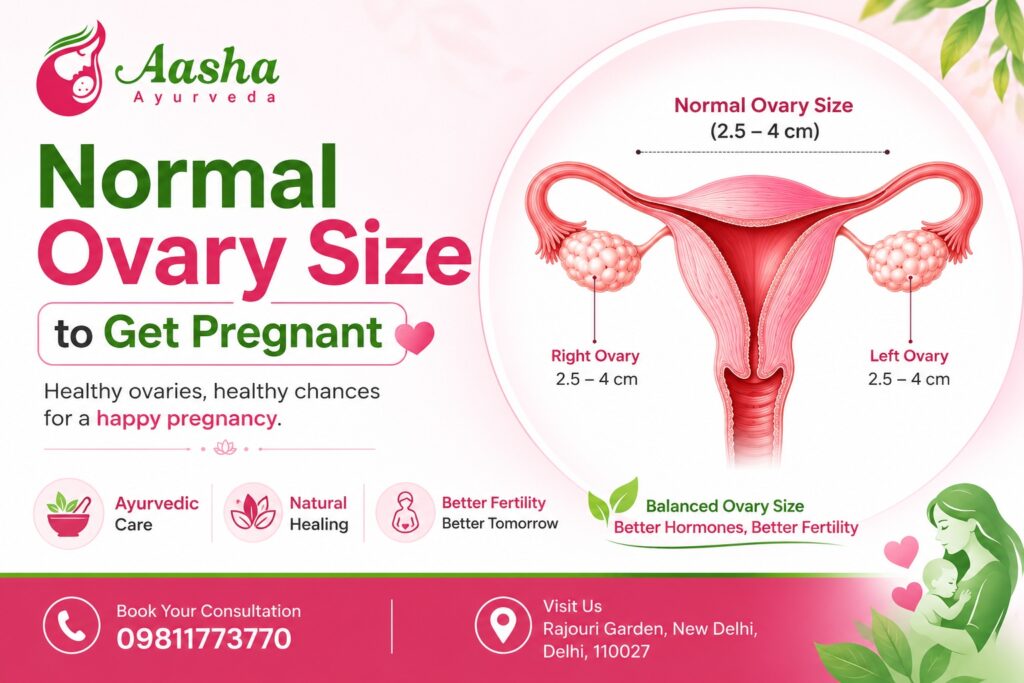
If you are planning a pregnancy, you may wonder: What is the normal ovary size to get pregnant? Ovarian size is one of several findings assessed during a pelvic ultrasound, but there is no single ideal ovary size that guarantees pregnancy.
In women of reproductive age, ovaries commonly measure approximately 2.5–5 cm (25–50 mm) in length, although dimensions and volume vary with age, menstrual-cycle phase, follicle development, pregnancy, and individual anatomy. More importantly, fertility depends on factors such as regular ovulation, egg quality, ovarian reserve, age, fallopian-tube health, the uterus, and sperm quality.
A woman can have ovaries within an expected size range and still experience difficulty conceiving. Likewise, ovaries that are somewhat smaller or larger do not automatically mean that pregnancy is impossible.
At Aasha Ayurveda, we encourage women to understand ovarian measurements as one part of a complete fertility assessment rather than judging pregnancy chances from an ultrasound number alone.
What Is the Normal Ovary Size to Get Pregnant?
There is no medically defined “perfect ovary size” required to become pregnant. In reproductive-age women, an ovary commonly measures around:
- Length: 2.5–5 cm or 25–50 mm
- Width: approximately 1.5–3 cm or 15–30 mm
- Thickness: approximately 0.6–2.2 cm or 6–22 mm
- Volume: varies with age, cycle phase, follicles, and clinical context
These are general reference ranges rather than fertility cutoffs.
An ovary’s ability to support conception cannot be determined by its physical size alone. Doctors usually assess ovarian function together with ovulation, antral follicle count (AFC), Anti-Müllerian Hormone (AMH), age, menstrual history, and other fertility factors.
What Ovary Size Is Good for Pregnancy?
A reproductive-age ovary is commonly around 2.5–5 cm long, but there is no specific ovary size that guarantees pregnancy. Healthy ovulation, egg quality, ovarian reserve, open fallopian tubes, a receptive uterus, age, and sperm health are generally more important for conception than ovarian dimensions alone.
Ovaries Normal Size: What Is Considered Healthy?
The phrase “ovaries normal size” generally refers to ovarian dimensions and volume that are appropriate for a woman’s age and reproductive stage.
The ovaries are dynamic organs. Their appearance changes throughout the menstrual cycle because follicles grow inside them. One ovary may temporarily become larger when it contains a dominant follicle or corpus luteum.
Normal Ovary Size Chart
| Measurement | Common Reproductive-Age Range |
| Length | Approximately 2.5–5 cm |
| Length in MM | Approximately 25–50 mm |
| Width | Approximately 1.5–3 cm |
| Width in MM | Approximately 15–30 mm |
| Thickness | Approximately 0.6–2.2 cm |
| Thickness in MM | Approximately 6–22 mm |
| Volume | Variable; interpreted by age and clinical context |
These values should not be treated as strict diagnostic boundaries. Ultrasound measurements can differ according to menstrual-cycle timing, follicle development, imaging technique, hormonal medications, pregnancy, and menopause.
Right and Left Ovary Normal Size in CM
The right and left ovary normal size in cm is generally similar, but both ovaries do not need to have exactly identical measurements.
A reproductive-age ovary may commonly measure:
- 2.5–5 cm in length
- 1.5–3 cm in width
- 0.6–2.2 cm in thickness
A small difference between the two ovaries is often physiological.
Right Ovary Normal Size in CM
The right ovary may measure approximately 2.5–5 cm in length, with its other dimensions varying according to anatomy and the menstrual cycle.
For example, the right ovary may appear temporarily larger when it contains the follicle that is preparing to release an egg.
Left Ovary Normal Size in CM
The left ovary generally falls within a similar range. It may be slightly larger or smaller than the right ovary without indicating a fertility problem.
Doctors do not normally determine whether an ovary is healthy simply by comparing its size with the opposite ovary.
Should the Right and Left Ovary Be the Same Size?
No. The right and left ovaries do not have to be exactly the same size.
Differences can occur because of:
- Dominant follicle development
- Recent ovulation
- Corpus luteum formation
- Functional ovarian cysts
- Natural anatomical variation
- Hormonal stimulation
The internal appearance of the ovaries, follicles, symptoms, and clinical history are more informative than a small difference in dimensions.
Right and Left Ovary Normal Size in MM
Ultrasound reports often record ovarian measurements in millimeters. The right and left ovary normal size in mm can therefore appear as three numbers, such as:
35 × 24 × 18 mm
These usually represent three dimensions of the ovary.
As a general reference, a reproductive-age ovary may measure approximately:
- Length: 25–50 mm
- Width: 15–30 mm
- Thickness: 6–22 mm
These measurements vary naturally and should be interpreted as part of the complete ultrasound.
Right Ovary Size in MM
The right ovary size in mm is commonly reported as length × width × thickness.
For example:
Right ovary: 36 × 25 × 19 mm
This means:
- Length: 36 mm or 3.6 cm
- Width: 25 mm or 2.5 cm
- Thickness: 19 mm or 1.9 cm
Whether an individual measurement is clinically normal depends on age, menstrual phase, ovarian appearance, follicles, cysts, symptoms, and other findings.
A single measurement should therefore not be used to diagnose infertility, PCOS, or diminished ovarian reserve.
Normal Size of Ovary in MM
The normal size of ovary in mm during reproductive years commonly falls around 25–50 mm in length, with width and thickness varying.
A useful reference is:
| Dimension | MM | CM |
| Length | 25–50 mm | 2.5–5 cm |
| Width | 15–30 mm | 1.5–3 cm |
| Thickness | 6–22 mm | 0.6–2.2 cm |
How to Convert Ovary Size From MM to CM
The conversion is simple:
10 mm = 1 cm
Examples:
- 30 mm = 3 cm
- 35 mm = 3.5 cm
- 40 mm = 4 cm
- 45 mm = 4.5 cm
- 50 mm = 5 cm
Therefore, if an ultrasound says an ovary measures 35 × 24 × 18 mm, this corresponds to approximately 3.5 × 2.4 × 1.8 cm.
Normal Ovary Size Chart in MM, CM and CC
| Parameter | Approximate Measurement |
| Ovary Length | 25–50 mm / 2.5–5 cm |
| Ovary Width | 15–30 mm / 1.5–3 cm |
| Ovary Thickness | 6–22 mm / 0.6–2.2 cm |
| Ovarian Volume | Variable according to age, cycle and clinical context |
| Right vs Left Ovary | Small differences are common |
Important: CC refers to cubic centimeters and measures volume, whereas CM and MM describe linear dimensions. They should not be directly compared as if they represent the same type of measurement.
Does Ovary Size Affect Your Chances of Getting Pregnant?
Ovary size can provide useful information, but ovarian dimensions alone cannot predict whether a woman will become pregnant.
Several factors are more important.
1. Ovulation
Pregnancy usually requires the release of a mature egg.
Women who ovulate regularly may conceive even when their two ovaries differ somewhat in size.
Irregular or absent ovulation can make conception more difficult and may occur with conditions such as PCOS, thyroid disorders, high prolactin levels, or other hormonal problems.
2. Ovarian Reserve
Ovarian reserve refers broadly to the remaining egg supply.
Doctors may assess it using:
- AMH testing
- Antral Follicle Count
- FSH and estradiol in appropriate clinical contexts
- Age and reproductive history
Ovary size alone is not an accurate measurement of the number of eggs remaining.
3. Egg Quality
Ovary size is not the same as egg quality.
Egg quality is strongly influenced by age and biological factors. A larger ovary does not automatically contain better-quality eggs, and a smaller ovary does not necessarily mean that all eggs are poor quality.
4. Age
Female age is one of the most important fertility factors because both egg quantity and average egg quality decline over time.
This is why two women with similar ovarian measurements may have very different fertility profiles.
5. Hormonal Health
Hormones involved in reproductive function include:
- FSH
- LH
- Estradiol
- Progesterone
- AMH
- Thyroid hormones
- Prolactin
Doctors interpret these tests according to symptoms, age, cycle timing, and fertility history.
Which Ovary Is Better for Pregnancy: Right or Left?
Neither ovary is inherently better for pregnancy.
Both the right and left ovary can develop follicles, release an egg, and contribute to conception.
Ovulation does not necessarily alternate perfectly from right to left every month. One ovary may ovulate during consecutive cycles.
Pregnancy depends more on whether:
- A healthy egg is released
- The relevant fallopian tube can pick up the egg
- Fertilization occurs
- The embryo reaches the uterus
- Implantation occurs successfully
Therefore, having a larger right ovary or left ovary does not automatically mean that side has better fertility.
Can You Get Pregnant With One Ovary?
Yes, pregnancy can be possible with one functioning ovary.
A single healthy ovary may continue to:
- Develop follicles
- Release eggs
- Produce reproductive hormones
Pregnancy chances depend on several additional factors, including age, ovarian reserve, ovulation, fallopian-tube function, uterine health, and sperm quality.
Women with one ovary who are concerned about fertility should discuss individualized assessment with a gynecologist or fertility specialist.
Can You Get Pregnant With Small Ovaries?
Pregnancy may still be possible with relatively small ovaries.
The physical size of an ovary does not independently determine whether conception can occur.
However, smaller ovaries in some situations may be associated with:
- Increasing age
- Reduced follicle number
- Diminished ovarian reserve
- Premature ovarian insufficiency
- Menopausal changes
The significance depends heavily on age and clinical findings.
Does Small Ovary Size Mean Low AMH?
Not necessarily.
AMH is produced by cells associated with developing ovarian follicles and is used as a marker of ovarian reserve. Although ovarian morphology and reserve can sometimes be related, you cannot accurately predict an individual’s AMH level from ovary size alone.
Tests such as AMH and AFC provide more useful information when ovarian reserve is being assessed.
Can Enlarged Ovaries Affect Pregnancy?
Enlarged ovaries do not automatically mean infertility.
Possible reasons for ovarian enlargement include:
- Normal follicle development
- Corpus luteum
- Functional ovarian cysts
- PCOS
- Endometriomas
- Fertility medications
- Benign ovarian growths
- Less commonly, serious ovarian conditions
The effect on fertility depends on the underlying cause rather than size alone.
Sudden severe pelvic pain, especially with nausea or vomiting, requires urgent medical assessment because ovarian torsion and other acute conditions need prompt evaluation.
Normal Ovary Size in PCOS and Pregnancy Chances
Polycystic Ovary Syndrome (PCOS) is a hormonal and metabolic condition that can affect menstrual cycles and ovulation.
Some people with PCOS have increased ovarian volume and a higher number of small follicles, while others may not have obviously enlarged ovaries.
Does PCOS Make Ovaries Bigger?
It can, but not in every case.
Ultrasound may show:
- Increased ovarian volume
- Numerous small follicles
- Changes in ovarian morphology
However, PCOS should not be diagnosed from ovarian size alone.
Doctors consider menstrual or ovulatory dysfunction, signs or laboratory evidence of androgen excess, ultrasound findings where appropriate, and exclusion of other possible conditions.
Can You Get Pregnant With Polycystic Ovaries?
Yes. Many women with PCOS become pregnant naturally or with appropriate treatment.
One common fertility challenge in PCOS is irregular ovulation. Treatment depends on individual factors such as age, symptoms, metabolic health, ovulation pattern, and how long pregnancy has been attempted.
Normal Ovary vs Polycystic Ovary
| Feature | Typical Ovary | PCOS May Involve |
| Ovarian Volume | Appropriate for age/cycle | May be increased |
| Follicles | Normal cycle-dependent pattern | Higher number of small follicles may occur |
| Ovulation | Often regular | May be irregular or absent |
| Menstrual Cycle | Often regular | May be irregular |
| Fertility | Depends on many factors | Irregular ovulation may reduce chances per cycle |
Ultrasound appearance alone does not establish PCOS.
Ovary Size vs Follicle Size: What Matters More for Pregnancy?
Ovary size and follicle size are two different measurements.
An ovary is the reproductive organ containing many follicles.
A follicle is a fluid-filled structure inside the ovary in which an egg develops.
During a menstrual cycle, one follicle often becomes dominant and grows before ovulation.
What Is a Dominant Follicle?
A dominant follicle is the follicle selected during a menstrual cycle that continues developing toward ovulation.
Doctors may monitor follicular growth using transvaginal ultrasound when assessing ovulation or fertility treatment.
What Follicle Size Is Associated With Ovulation?
A dominant follicle often reaches approximately 18–24 mm around the time of ovulation, although normal variation occurs and size alone cannot confirm that ovulation has happened.
Clinical interpretation may include hormone changes, ultrasound follow-up, and evidence of follicle rupture or corpus luteum formation.
Does a Bigger Ovary Mean More Eggs?
No.
A larger ovary does not automatically mean:
- More eggs
- Better egg quality
- Higher fertility
- Greater pregnancy chances
Ovarian reserve is better evaluated using age, AMH, AFC, and clinical history.
Ovary Size vs AMH: Are They Related?
Ovary size and AMH provide different information.
| Fertility Indicator | What It Helps Assess |
| Ovary Size | Ovarian anatomy and volume |
| AMH | Marker related to ovarian reserve |
| AFC | Number of visible small antral follicles |
| Follicle Size | Development of an individual follicle |
| Ovulation | Whether an egg is released |
| Age | Major factor affecting egg quantity and quality |
AMH should also not be interpreted as a standalone “pregnancy test.” A low AMH result does not mean natural pregnancy is impossible, and a high AMH does not guarantee conception.
How to Read Your Ovary Size on an Ultrasound Report
Suppose an ultrasound report states:
Right Ovary: 35 × 24 × 18 mm
This typically represents three ovarian dimensions.
Converted into centimeters:
3.5 × 2.4 × 1.8 cm
The report may additionally describe:
- Ovarian volume
- Number and appearance of follicles
- Dominant follicle
- Corpus luteum
- Cysts
- Masses
- Blood-flow findings when Doppler is performed
What Does “Normal Bilateral Ovaries” Mean?
“Bilateral” means both sides.
If a report describes normal bilateral ovaries, it generally means both ovaries appear within expected limits on that examination, although the exact meaning depends on the complete radiology report.
What Does “Bulky Ovary” Mean?
“Bulky” generally means the ovary appears enlarged.
Possible explanations include normal cycle-related changes, PCOS morphology, cysts, or other conditions.
The term alone is not a diagnosis.
What Does Ovarian Volume Mean?
Ovarian volume estimates the three-dimensional size of an ovary.
It is generally calculated from:
- Length
- Width
- Thickness
Volume is reported in cc or mL, which are numerically equivalent for this purpose.
Normal Ovary Size by Age
Ovarian size changes throughout life.
Adolescence
Ovaries become more hormonally active after puberty and follicles begin developing with menstrual cycles.
20s and 30s
Ovarian activity is generally higher during reproductive years. Size can fluctuate with follicular development and ovulation.
Late 30s and 40s
Ovarian reserve generally declines with age, although the rate differs significantly among individuals.
Perimenopause
As reproductive function declines, follicle numbers decrease and ovarian size may gradually reduce.
Postmenopause
Ovaries generally become smaller after menopause because follicular activity and reproductive hormone production decline substantially.
Age is therefore essential when interpreting whether an ovarian measurement is expected.
What Factors Affect Ovary Size?
Ovarian measurements may change because of:
- Age
- Menstrual-cycle phase
- Dominant follicle development
- Ovulation
- Corpus luteum formation
- Pregnancy
- PCOS
- Ovarian cysts
- Endometriosis/endometriomas
- Fertility medications
- Hormonal changes
- Menopause
For this reason, a single ovarian measurement without clinical context provides limited information.
What Is More Important Than Ovary Size for Getting Pregnant?
Several fertility factors are more informative than ovarian dimensions alone:
- Regular ovulation: An egg needs to mature and be released.
- Egg quality: Particularly influenced by age.
- Ovarian reserve: Assessed using age, AMH, AFC, and clinical history.
- Fallopian-tube health: At least one functional pathway is generally needed for natural conception.
- Uterine and endometrial health: Important for implantation and pregnancy development.
- Hormonal health: Reproductive and endocrine hormones influence ovulation.
- Age: A major determinant of female fertility.
- Sperm health: Male-factor fertility contributes substantially to a couple’s chance of conception.
Key takeaway: A normal ovary size does not guarantee pregnancy, and an ovary outside an average size range does not automatically mean infertility.
Tests That Help Evaluate Ovarian Health and Fertility
If pregnancy is taking longer than expected, healthcare professionals may recommend several investigations.
Pelvic Ultrasound
Assesses:
- Ovaries
- Follicles
- Uterus
- Endometrium
- Cysts or other pelvic abnormalities
AMH Test
AMH can provide information related to ovarian reserve, particularly in fertility-treatment planning.
It does not directly measure egg quality or guarantee natural pregnancy.
Antral Follicle Count (AFC)
An ultrasound-based count of small follicles visible in the ovaries, often used alongside AMH when assessing ovarian reserve.
FSH, LH and Estradiol
These hormones may be assessed depending on cycle timing and the clinical situation.
Follicular Monitoring
Serial ultrasounds can track:
- Follicle growth
- Endometrial development
- Signs associated with ovulation
HSG or Other Tubal Assessment
Tests such as hysterosalpingography may be used to evaluate whether the fallopian tubes appear open.
Semen Analysis
Fertility assessment should not focus only on the female partner. Semen analysis evaluates important male fertility parameters and is commonly part of a couple’s infertility evaluation.
How to Support Ovarian and Reproductive Health Naturally
No diet, herb, supplement, or lifestyle technique can guarantee pregnancy or increase egg supply. However, healthy habits can support overall reproductive and metabolic health.
Helpful measures may include:
- Eating a varied, balanced diet
- Maintaining an appropriate body weight
- Getting regular physical activity
- Sleeping adequately
- Managing chronic stress
- Avoiding smoking and tobacco
- Limiting or avoiding alcohol when trying to conceive
- Managing PCOS, thyroid disorders, diabetes, and other health conditions
- Attending regular medical check-ups
- Taking folic acid before conception according to medical guidance
Speak with a healthcare professional before taking fertility supplements or herbal medicines, particularly if you use prescription medication or are undergoing fertility treatment.
Ayurvedic Approach to Reproductive Wellness at Aasha Ayurveda
At Aasha Ayurveda, reproductive wellness is approached holistically by considering menstrual patterns, lifestyle, nutrition, sleep, stress, digestion, and individual health concerns.
Depending on individual needs, supportive care may focus on:
- Menstrual wellness
- Nutrition and lifestyle guidance
- Stress-management practices
- Preconception wellness
- PCOS-related lifestyle support
- Overall reproductive well-being
Ayurvedic care should complement rather than replace appropriate gynecological or fertility evaluation.
Women with low AMH, irregular ovulation, blocked fallopian tubes, endometriosis, ovarian cysts, recurrent pregnancy loss, or prolonged infertility should obtain an appropriate medical diagnosis before relying on complementary approaches.
When Should You Consult a Fertility Specialist?
Consider seeking professional fertility advice if:
- You are under 35 and have been trying to conceive for approximately 12 months without pregnancy.
- You are 35 or older and have been trying for approximately 6 months.
- You are over 40 and planning pregnancy.
- Your periods are very irregular or absent.
- You have known or suspected PCOS.
- You have endometriosis.
- You have had previous ovarian or pelvic surgery.
- You have known fallopian-tube problems.
- You have concerns about low ovarian reserve.
- You or your partner have known fertility-related conditions.
Earlier evaluation may be appropriate depending on medical history.
Frequently Asked Questions
Q1. What is the normal ovary size to get pregnant?
There is no single ideal ovarian size for pregnancy. A reproductive-age ovary commonly measures around 2.5–5 cm in length, but fertility depends on much more than ovarian dimensions.
Q2. What is the normal size of ovaries in women?
Ovarian size varies by age and menstrual status. During reproductive years, ovaries commonly measure approximately 2.5–5 cm long.
Q3. What is the normal size of ovary in mm?
A common reference range is approximately 25–50 mm in length, 15–30 mm in width, and 6–22 mm in thickness.
Q4. What is the right ovary size in mm?
The right ovary commonly measures approximately 25–50 mm in length during reproductive years, but the complete three-dimensional measurement and clinical context should be considered.
Q5. What is the normal left ovary size in mm?
The left ovary generally has a similar reference range to the right ovary, although small differences between sides are common.
Q6. What is the right and left ovary normal size in mm?
Both ovaries commonly measure approximately 25–50 mm in length. Width and thickness vary according to age, cycle phase, and follicular activity.
Q7. What is the right and left ovary normal size in cm?
Both ovaries commonly measure around 2.5–5 cm in length during reproductive years, but normal variation is expected.
Q8. Does ovary size affect pregnancy chances?
Not by itself. Ovulation, age, egg quality, ovarian reserve, fallopian tubes, uterine health, and sperm quality are more important determinants.
Q9. Which ovary is best for getting pregnant?
Neither. A healthy egg released from either ovary can potentially result in pregnancy.
Q10. Can I get pregnant if my right ovary is small?
Potentially, yes. Pregnancy depends on whether functional ovulation occurs and on other female and male fertility factors.
Q11. Can I get pregnant with one ovary?
Yes, many women can conceive with one functioning ovary, depending on age and other fertility factors.
Q12. Can small ovaries release healthy eggs?
Yes. Physical ovarian size alone does not determine egg quality.
Q13. Does a bigger ovary mean more eggs?
No. A larger measurement does not necessarily indicate a greater ovarian reserve.
Q14. What ovarian volume is considered normal?
Ovarian volume varies substantially with age, menstrual-cycle phase, and reproductive status. It should be interpreted using age-appropriate clinical and ultrasound criteria rather than one universal fertility cutoff.
Q15. Is a 10 cc ovary normal?
An ovarian volume around 10 cc can occur in reproductive-age women. Whether it is considered expected depends on age, menstrual phase, follicle pattern, symptoms, and the clinical question being evaluated.
Q16. Does PCOS increase ovary size?
PCOS can be associated with increased ovarian volume and a higher number of small follicles, but not every woman with PCOS has enlarged ovaries.
17. Can enlarged ovaries cause infertility?
Enlargement itself is not necessarily the cause. The underlying condition—such as irregular ovulation from PCOS or certain ovarian disorders—may affect fertility.
Q18. What is the difference between ovary size and follicle size?
The ovary is the reproductive organ, while a follicle is a small fluid-filled structure inside the ovary containing a developing egg.
Q19. What follicle size is needed for pregnancy?
A dominant follicle commonly reaches approximately 18–24 mm around ovulation, but follicle size alone cannot guarantee ovulation, fertilization, or pregnancy.
Q20. Does low AMH mean small ovaries?
Not necessarily. AMH and ovarian size are different measurements. AMH relates to the pool of developing follicles and should be interpreted alongside age, AFC, and clinical history.
Q21. Can ovarian size change every month?
Yes. Follicle growth, ovulation, and corpus luteum formation can change ovarian dimensions during each menstrual cycle.
Q22. Does ovarian size decrease with age?
Generally, yes. As follicle numbers and reproductive activity decline with age and menopause, ovaries tend to become smaller.
Q23. How do I know if my ovaries are healthy?
No single test defines ovarian health. Doctors may assess menstrual cycles, ultrasound findings, ovulation, AMH/AFC where appropriate, symptoms, age, and medical history.
Q24. Can Ayurveda support ovarian health?
Ayurvedic approaches may support general wellness through individualized nutrition, lifestyle, sleep, and stress-management strategies. They should complement appropriate medical assessment rather than replace diagnosis or fertility treatment when needed.
Q25. When should I see a fertility specialist?
Seek evaluation after about 12 months of trying if under 35, or after about 6 months if 35 or older. Earlier assessment may be appropriate with irregular periods, endometriosis, known tubal problems, ovarian concerns, or other fertility risk factors.
Q26. What is the normal ovary size to get pregnant?
There is no specific ovary size required to get pregnant. In reproductive-age women, ovaries commonly measure about 2.5–5 cm or 25–50 mm in length. Pregnancy depends more on ovulation, egg quality, ovarian reserve, age, healthy fallopian tubes, uterine factors, and sperm quality than on ovary size alone.
Q27. What is the normal size of ovary in mm?
A reproductive-age ovary commonly measures approximately 25–50 mm in length, 15–30 mm in width, and 6–22 mm in thickness. These are general reference ranges. Normal ovarian measurements vary with age, menstrual-cycle phase, follicles, hormonal status, and individual anatomy.
28. What is the right ovary size in mm?
The right ovary in a reproductive-age woman commonly measures approximately 25–50 mm in length, with width and thickness varying. A slightly larger or smaller measurement may still be normal depending on follicle development, menstrual-cycle timing, ovarian volume, age, and ultrasound appearance.
Q29. What is the right and left ovary normal size in mm?
Both right and left ovaries commonly measure approximately 25–50 mm long, 15–30 mm wide, and 6–22 mm thick during reproductive years. The ovaries do not need to have identical dimensions, as ovulation and follicle development can temporarily make one larger.
Q30. What is the right and left ovary normal size in cm?
The right and left ovaries commonly measure approximately 2.5–5 cm in length, 1.5–3 cm in width, and 0.6–2.2 cm in thickness in reproductive-age women. Measurements vary with age, menstrual cycle, ovulation, pregnancy, and individual anatomy.
Q31. Does ovary size matter for pregnancy?
Ovary size alone does not determine whether a woman can become pregnant. Fertility depends on multiple factors, including ovulation, egg quality, ovarian reserve, age, fallopian-tube health, uterine conditions, and sperm quality. Ovarian measurements should therefore be interpreted as part of a complete fertility assessment.
Q32. Can small ovaries get pregnant?
Yes, pregnancy may be possible with relatively small ovaries if ovulation occurs and other fertility factors are favorable. However, smaller ovaries can sometimes be associated with age-related changes or reduced ovarian reserve, so AMH, AFC, age, and clinical history may need evaluation.
Q33. Which ovary is best for pregnancy?
Neither the right nor left ovary is inherently better for pregnancy. Both ovaries can develop and release healthy eggs. Conception depends on successful ovulation, egg and sperm health, fallopian-tube function, fertilization, and implantation rather than whether ovulation occurs from the right or left side.
Q34. Does a bigger ovary mean more eggs?
No. A bigger ovary does not automatically mean a woman has more eggs or better fertility. Ovarian size can increase because of follicles, ovulation, PCOS, or cysts. Ovarian reserve is more appropriately assessed using age, AMH, antral follicle count, and clinical evaluation.
Does Normal Ovary Size Guarantee Pregnancy?
Understanding the normal ovary size to get pregnant can make an ultrasound report easier to interpret, but ovarian size should never be viewed as a standalone fertility score.
During reproductive years, the right and left ovary normal size in cm commonly falls around 2.5–5 cm in length, while the right and left ovary normal size in mm is approximately 25–50 mm in length. Width, thickness, and ovarian volume vary according to age, menstrual-cycle phase, follicle development, and individual anatomy.
Most importantly, there is no specific ovarian measurement that guarantees conception.
Successful pregnancy depends on several interconnected factors, including regular ovulation, egg quality, ovarian reserve, age, healthy fallopian tubes, uterine and endometrial health, and sperm quality.
If your ultrasound shows small, enlarged, bulky, or unequal ovaries, avoid drawing conclusions from the measurements alone. A gynecologist or fertility specialist can interpret the findings alongside your symptoms, menstrual history, AMH/AFC when appropriate, and other fertility investigations.
At Aasha Ayurveda, the focus is on supporting women’s reproductive wellness through personalized Ayurvedic guidance, nutrition, lifestyle, stress management, and preconception support alongside appropriate conventional medical evaluation.
If you are trying to conceive or have concerns about ovarian health, PCOS, irregular periods, low ovarian reserve, or fertility, obtaining an individualized assessment is the most reliable next step.